Moon: Scientists develop a new way to detect hidden water ice on the Moon using seismic waves |

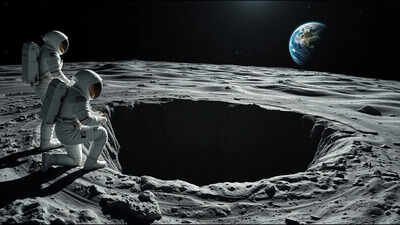
Representative Image of astronauts investigating potential water ice reserves on the Moon (AI-generated image) Beneath the permanently shadowed craters near the Moon’s south pole, scientists believe significant deposits of water ice may be buried out of reach of the instruments currently used to search for it from orbit. A new study led by researchers at…

Read More

This 6,000 km long underground city stretching from Portugal to Italy is built by the Argentine ants across the coasts of four European countries |

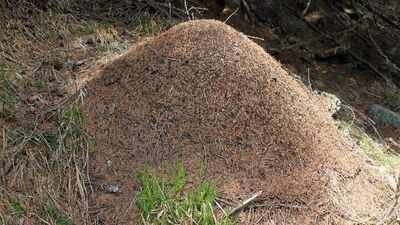
Ant Supercolony. Image Credit: Anagoria/Wikipedia The Argentine ant (Linepithema humile) has created one of the most remarkable biological phenomena ever recorded: a super-colony stretching around 6,000 kilometres along the Mediterranean and Atlantic coasts of Portugal, Spain, France and Italy. According to a study published in the Proceedings of the National Academy of Sciences (PNAS), these…

Read More

Scientists discover humans and mice may use the same hidden brain system to recognise smells |

Representative Image of a mouse and a human side by side, both engaged in sniffing (AI-generated image) A mouse hunting for food might sniff several times a second. A person checking whether a cantaloupe is ripe usually leans in for a single, unhurried breath. On the surface, these look like completely different behaviours. Two complementary…

Read More

A new island has emerged in Alaska after a glacier melted away: Nasa images reveal a stark sign of climate change |

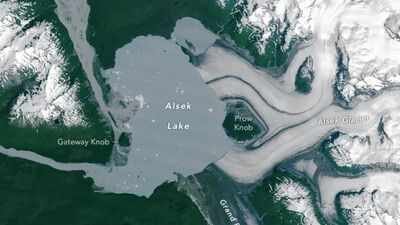
Alsek on July 5, 1984. Image Credit: NASA Earth Observatory images by Michala Garrison, using Landsat data from the US Geological Survey. The coastal plain of southeastern Alaska is currently witnessing a rapid transformation where water is replacing ice at an unprecedented rate. Glaciers in this region are melting, which leads to the formation of…

Read More

Scientists discover Black pine jewel beetles use heat, smoke and infrared organs to find wildfires using nature’s most sophisticated sensory system |

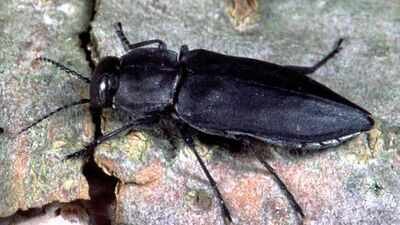
Black fire beetle, Melanophila acuminata. Image Credit: Prof. Schmitz/Wikipedia Black pine jewel beetles, scientifically named Melanophila acuminata, belong to a unique group of insects that exhibit pyrophilous behaviour, which means they are naturally attracted to forest fires. These beetles are primarily found across boreal and temperate forests of the north, where they play a vital…

Read More

For more than 125 years, horses have quietly helped save snakebite victims. Here’s how their blood becomes life-saving antivenom |

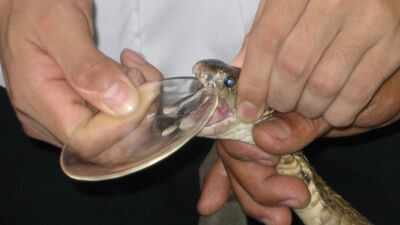
Milking a snake for the production of antivenom. Image Credit: Barry Rogge/Wikipedia Snakebite envenomation(condition where toxic venom is injected into a body via the bite, sting, or puncture of a venomous animal such as a snake, spider, scorpion, or insect), remains a global health issue, causing up to 100,000 deaths per year and affecting millions…

Read More

In 1898, Chesapeake Bay was so full of oysters that one grew on a lost set of dentures; today, more than 99% of the historic native population has disappeared

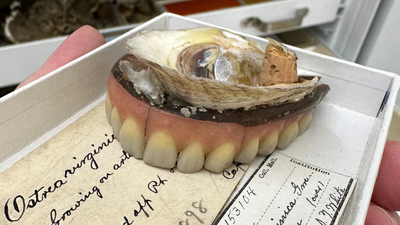
An eastern oyster (Crassostrea virginica) attached to an upper set of artificial teeth (Source: Smithsonian Institution) In 1898, a dredging boat pulling debris from the floor of the Chesapeake Bay made a discovery that looked like something from a biological nightmare: a set of human dentures with a live oyster firmly attached to them.The unusual…

Read More

In 1934, scientists heard reports of mushrooms causing visions of tiny people; in 2026, DNA linked the phenomenon to one species in China and the Philippines

Lanmaoa asiatica is a popular edible mushroom species sold in Yunnan that induces Lilliputian hallucinations when undercooked. In 1934, Western scientists first heard reports from Papua New Guinea of wild mushrooms causing visions of tiny people, a phenomenon called “mushroom madness.” Nearly a century later, DNA sequencing has confirmed that a single, identical mushroom species…

Read More

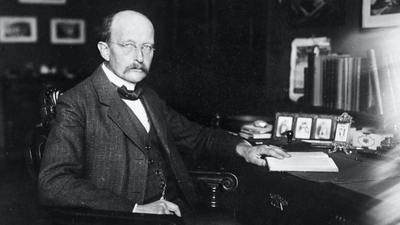
Max: Quote of the day by Max Planck: “Science cannot solve the ultimate mystery of nature. And that is because…” |

Few scientists have reshaped humanity’s understanding of the universe as profoundly as Max Planck. Celebrated as the father of quantum theory, the German physicist not only revolutionised modern physics but also left behind timeless reflections on science, philosophy and the limits of human knowledge. One of his most quoted observations is: “Science cannot solve the…

Read More