
Meet Lilah Mehta, the Connecticut high-school student who entered a Yale lab at 16 and is already a co-author of published research

When Lilah Mehta entered a biomedical research laboratory at Yale University as a 16-year-old high-school pupil, her main goal was to explore the biological questions that had interested her since her ninth-grade science classes. Two years later, the New Canaan resident and King School student in Stamford has reached an academic milestone rarely achieved before…

Read More

Gold miners have breached a refuge built for rescued orangutans; 14 hectares of Indonesia’s sanctuary damaged in 3 years

Illegal gold miners have encroached on Indonesia’s Jantho forest reservation, a vital reintroduction site for the critically endangered Sumatran orangutan. The country’s largest environmental pressure group, Indonesian Forum for the Environment, revealed that miners have breached the forest in Aceh province, where the animals rescued from illegal wildlife trade reside, according to a report by…

Read More

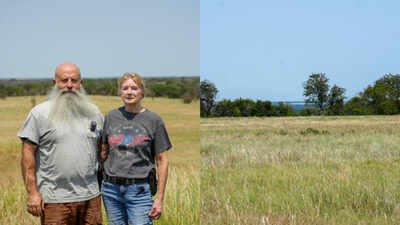
In Oklahoma, a veteran spent 5 years fighting back invasive cedars on his 400-acre ranch; now native grasses are returning and water is flowing into newly reappearing streams

Heishman started working with Duel Brown, the Pawnee County conservationist for the Natural Resources Conservation Service, who helped find practical ways to improve the property. Retired Marine Corps veteran Brian Heishman has been slowly turning a 400-acre ranch near Pawnee, Oklahoma, into a cedar forest for five years. An overgrown property, choked by Eastern Red…

Read More

End of the world: Scientists reveal 7 countries most likely to survive a global collapse by maintaining society and food production

With countries fighting wars and natural calamities sweeping away civilisations, it seems a global collapse might be a spark away. But the possibility of entire humanity vanishing off the face of Earth seems a little less plausible with the years of effort we have spent preparing solutions for such situations. However, not everyone can be…

Read More

This 12-year-old’s science-fair experiment turned a Lego robotics kit into a working Braille printer costing far less than commercial machines |

At 12, Shubham Banerjee was looking for a way to make Braille printing more affordable. His search began after he saw a letter asking for help for blind people during his family’s Christmas celebrations at home. When he learnt that Braille printers could cost more than $2,000, he wondered whether the technology could be built…

Read More

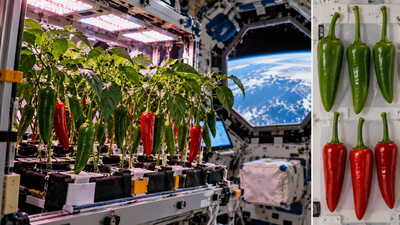
In 2021, Nasa grew Hatch chile peppers in microgravity; after 137 days, the plants produced 26 peppers with unusually straight stems |

In 2021, Nasa grew Hatch chile peppers aboard the International Space Station for the first time, producing edible fruit after 137 days in microgravity. The Plant Habitat-04 experiment was designed to test whether a fruiting crop could survive and produce food in orbit, an important step towards growing fresh produce during future missions to the…

Read More

In 1921, a 14-year-old Idaho farm boy imagined sending pictures through the air from a potato field, inspiring the invention of electronic television |

PC: Harris & Ewing/Wikipedia In 1921, a 14-year-old boy working in an Idaho potato field imagined something almost impossible: sending pictures through the air in the same way radio carried sound. His name was Philo Farnsworth, and the vision he had would eventually lead him towards electronic television. Farnsworth believed pictures could be transmitted as…

Read More

Hubble images revealed a giant 10-sided wave around Saturn’s south pole; one side stretches over 10,000 miles and the pattern has grown clearer since 2023

NASA’s Hubble captures Saturn’s mysterious 10-sided atmospheric wave at its south pole (Image: X/ @NASAHubble) Saturn has revealed another strange feature in its atmosphere, and this time it is hiding around the planet’s south pole. New observations from NASA’s Hubble Space Telescope have captured a giant, evolving 10-sided atmospheric wave encircling the southern pole of…

Read More

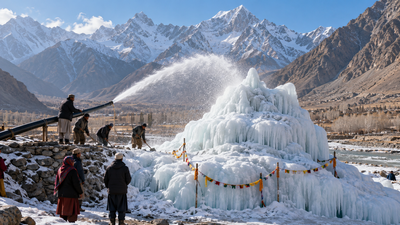
Communities marry glaciers in Gilgit-Baltistan to create artificial glaciers as climate change threatens water supplies |

High in the mountains of Gilgit-Baltistan, communities are reviving an age-old practice to answer a modern water crisis: they are ‘marrying’ glaciers. As natural glaciers shrink and meltwater becomes less reliable, local people are carrying pieces of ice from existing glaciers to carefully chosen sites, where male and female ice are brought together and buried…

Read More

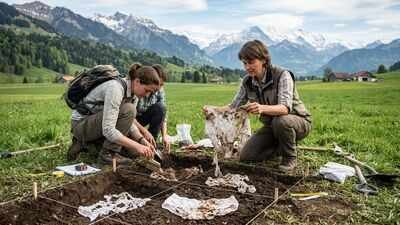
Scientists buried 2,000 pairs of cotton underwear across Switzerland; what they found revealed the health of the soil |

A pair of cotton pants is not usually considered scientific equipment. Yet across Switzerland, thousands of them spent weeks underground as part of an unusual experiment into the condition of the soil beneath people’s feet.More than 1,000 volunteers took part, burying underwear and teabags at sites ranging from private gardens and farmland to grasslands and…

Read More