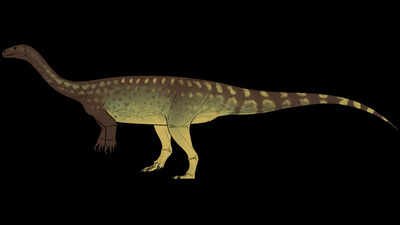
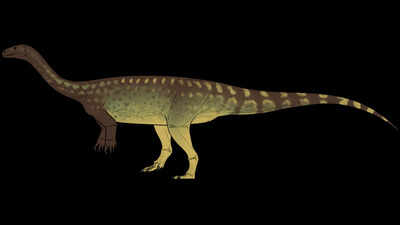
They say growing up heavy gives you personality. We certainly hope so for this young dinosaur, that weighed 400 kg at barely three years old. For perspective, that is roughly the weight of a grand piano, and this prehistoric heavyweight was nowhere near finished growing.Scientists in South Africa have identified a previously unknown dinosaur species from a fossilised skull and other bones dating back more than 200 million years. Named Nyana rooiwalensis, the dinosaur belonged to an early group of plant-eating dinosaurs whose descendants would eventually include some of the largest animals to ever walk the Earth. The findings, published in Royal Society Open Science, add valuable information to our understanding of early dinosaur evolution.But its impressive size as a youngster is not the only reason researchers are interested in this discovery. The fossil is offering a glimpse into how early dinosaurs grew, evolved and eventually became giants.
A skull that had been hiding in plain sight
The fossil was discovered in 2018 near Qhemegha village in South Africa’s Eastern Cape province. It was found in the lower Elliot Formation, a geological formation known for preserving fossils from the Late Triassic and Early Jurassic periods.The remains belonged to a juvenile dinosaur and included a remarkably well-preserved skull, along with parts of its spine, limbs and other bones. Measuring approximately 21.3 centimetres, the skull contained several important structures, including much of the braincase, the palate and the hyoid, a small bone structure associated with the throat.Researchers led by Atashni Moopen from the University of the Witwatersrand used powerful X-rays to examine the fossil and create a detailed three-dimensional reconstruction. The scans were carried out using the European Synchrotron Radiation Facility, which uses intense X-ray beams to reveal internal details without having to physically dismantle the fossil.By comparing the skull’s anatomical features with those of other known dinosaurs, the team was able to establish that the remains belonged to a previously unidentified species.Well-preserved skulls from early sauropodomorphs rarely come by, especially in southern Africa. Having an almost complete specimen gives scientists more anatomical information to work with when studying how these dinosaurs were related to one another.
A heavyweight that was still growing
While the skull helped identify the species, it was the dinosaur’s limb bones that revealed just how unusual its growth was. Researchers examined thin slices of its fossilised bones under a microscope, looking for growth marks. Much like the rings found inside tree trunks, certain structures in dinosaur bones can provide clues about an animal’s age and how quickly it was growing.The examination revealed at most two lines of arrested growth, which are marks left when bone growth temporarily slows down. Combined with the structure of the bone’s outer surface, this suggested that the animal was still in an early stage of development when it died. Scientists estimated that Nyana was at least in its third year of growth. Despite its young age, its body mass was already estimated at approximately 400 kilograms.This figure was calculated by measuring the circumference of its thigh bone and comparing it with growth curves developed from related dinosaurs. In other words, researchers did not have a complete skeleton to weigh, but used the preserved bones and comparisons with other species to estimate its size.And it appears that Nyana was only getting started. By extending these growth curves, the researchers suggested that a fully grown individual could have reached a body mass of several tonnes. This remains an estimate rather than a confirmed adult size, since scientists have not yet found an adult specimen of the species. Its estimated body mass was more than four times that of similarly aged Massospondylus and Mussaurus individuals.
A missing piece in dinosaur evolution
Nyana belonged to a group called sauropodomorphs, which included some of the earliest ancestors and relatives of the enormous, long-necked dinosaurs that would appear later in Earth’s history. The group eventually gave rise to giants such as Brachiosaurus and Diplodocus, known for their extraordinary size and long necks and tails. Unlike these later giants, Nyana probably walked on two legs.The discovery offers researchers an opportunity to investigate how the group developed the ability to grow so large. Its bone structure suggests that rapid growth was already taking place relatively early in sauropodomorph evolution, long before the appearance of the enormous sauropods that would become familiar to us.There may also be an interesting geographical connection hidden in its ancestry. Based on their analysis, researchers suggest that Nyana could have been closely related either to Sarahsaurus, a dinosaur discovered in North America, or to Ngwevu, another South African dinosaur. Its exact position on the dinosaur family tree is still uncertain, but either possibility could help scientists understand how these prehistoric animals were distributed across different continents.Nyana may never have reached its full potential, but even a youngster weighing 400 kilograms has managed to leave quite a sizeable impression on palaeontology.