Scientists built a system that watches activity across nearly every cell of a living vertebrate at once; transparent zebrafish revealed body-wide signals moving between organs
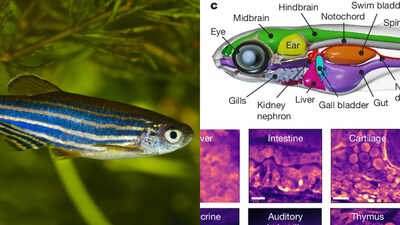
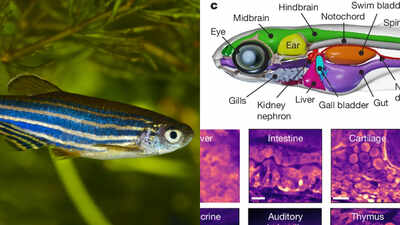
The body is never truly quiet. Even when an animal appears to be resting, billions of cells are sending signals, responding to changes and coordinating with organs far beyond their immediate surroundings. For scientists, the challenge has always been hearing enough of that conversation at once. Researchers at HHMI’s Janelia Research Campus have now developed a system called WHOLISTIC, short for Whole Organism Live Imaging System for recording Tissue and IntraCellular activity. Published in the journal called Nature, the report states that the technology can capture real-time cellular activity across nearly the entire body of a living vertebrate, offering an unusually broad view of how organs and cells work together.Using transparent larval zebrafish, the team observed activity across systems including the brain, muscles, cardiovascular system and digestive organs simultaneously as the animals moved, ate and rested.
From individual cells to the whole animal
The work was developed by Virginie Ruetten, a postdoctoral researcher in Misha Ahrens’ Janelia lab, along with collaborators at University College London, Virginia Tech and Tsinghua University. The key for the study was calcium. Nearly every cell uses changes in calcium levels to communicate and coordinate activity. By making these changes visible, researchers could follow the signals passing through different parts of the body.The Ahrens lab had previously developed techniques for recording calcium activity throughout the brain of larval zebrafish. WHOLISTIC takes that idea much further by extending the view beyond the brain and into the rest of the animal. The researchers first introduced a calcium sensor into cells throughout the fish. They then used specialized microscopy to capture the signals, developed computational tools to align and interpret the enormous amount of data, and used whole-body expansion microscopy to examine the animals at much higher resolution. The result is a system that can move between two scales that are normally studied separately: individual cells and the entire organism.According to the study, this gap has long limited researchers’ ability to understand how different biological systems interact. Ruetten describes the approach as a way to bridge those two fundamental scales of biology and fill an observability gap that has made cellular responses difficult to study at such scale.
The body is more connected than it looks
WHOLISTIC has already revealed patterns that might be missed when scientists examine organs individually. Researchers found widespread correlations between activity in the brain, muscles and internal organs. They also discovered that many cell types have distinctive patterns of activity over time, potentially allowing scientists to identify cells based on their behavior even when they lack specific labels.One particularly striking finding emerged when the fish experienced low-oxygen conditions. The researchers observed a body-wide response in which the brainstem helped redirect blood flow away from the gut and toward the brain and muscles, revealing how several systems cooperate to help the animal survive.The technology also uncovered waves of activity traveling along the spinal cord and brain during extended periods of motor inactivity. These signals originated in ependymal cells, which line the fluid-filled spaces of the central nervous system, raising the possibility that these cells have a role in sleep.Other experiments identified cells that respond to cold, including chondrocytes, the cells that make up cartilage, and showed that ketamine activates not only neurons but also cells and connective tissue surrounding the brain.
A wider view of behavior
The researchers are now adapting WHOLISTIC for Danionella, a tiny fish that remains transparent throughout its life. Unlike larval zebrafish, Danionella can therefore provide a window into more developed animals and more complex behaviors. Ahrens sees the broader approach as a way to rethink how scientists study biological systems. Looking only at the brain to understand behavior, he says, is similar to trying to understand a large corporation by examining only one department. The important clues may lie in the flow of information between different parts of the organization. For now, WHOLISTIC is still a long way from providing a complete picture of an entire human body. But by allowing researchers to watch cells, organs and behavior unfold together, the technique offers something biology has rarely had: a chance to see the pieces of a living system communicating in real time.Images Courtesy: istock and Nature