Melting icebergs create new deep-sea habitats 2,500 metres beneath the Arctic Ocean as rocks transform the seafloor |
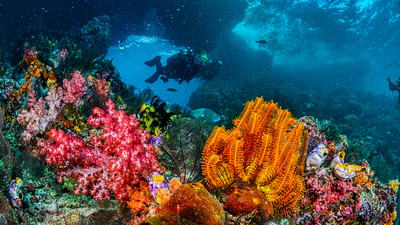
Climate change is often framed as a story of ecological loss, but scientists have uncovered an unexpected consequence unfolding nearly 2,500 metres beneath the Arctic Ocean. As glaciers in Greenland and parts of the Russian Arctic destabilise, increasing numbers of debris-laden icebergs are drifting through the Fram Strait before melting and releasing vast quantities of rock onto the seafloor. These stones, known as dropstones, are creating rare hard surfaces across an otherwise muddy deep-sea landscape. Researchers have found that the newly deposited rocks are becoming settlement sites for sponges, sea anemones, corals and other marine organisms that require solid ground to survive. The discovery offers a striking example of how global warming is reshaping ecosystems in complex and often unexpected ways, altering where life can exist in one of Earth’s fastest-changing regions.
Arctic icebergs are transporting tonnes of rock across the ocean floor
The findings come from a study, ‘Amplified Arctic iceberg traffic reshapes benthic biodiversity,’ by researchers from the Alfred Wegener Institute and the Woods Hole Oceanographic Institution. In the 2026 study published in Nature, Krumpen, Meyer-Kaiser, and colleagues identified a climate-driven mechanism where accelerating glacier disintegration increases deep-sea hard-bottom habitats. On June 14, 2021, during the RV Polarstern expedition PS126, researchers visited a specific iceberg in the vicinity of the HAUSGARTEN observatory (78° 35.66′ N, 3° 32.92′ W) that was carrying a significant load of dark lithogenic material. Scientists encountered unusually dark icebergs in the Fram Strait between Greenland and Svalbard. The icebergs appeared almost black because they contained exceptionally large amounts of shale, quartz stones, gravel and rock scraped from Arctic landscapes by glaciers.According to marine biologist Melanie Bergmann of the Alfred Wegener Institute:“We immediately realised that tons of rock were drifting through the Arctic Ocean, hundreds of kilometres away from any glacier.”Subsequent analyses revealed that the increase in iceberg numbers since the early 2000s is linked to the destabilisation of major glaciers in north-east Greenland and parts of the Russian Arctic. Reduced sea-ice cover has also allowed icebergs to move more freely and melt more rapidly, accelerating the delivery of rocky debris to distant parts of the Arctic Ocean.Research further demonstrated that Greenland’s tidewater glaciers are capable of transporting enormous volumes of sediment through iceberg rafting, highlighting the scale of material movement occurring across the Arctic marine environment.
New biodiversity hotspots are emerging on the Arctic seafloor
Photographs collected from the long-term deep-sea observatory AWI-Hausgarten revealed a significant increase in stone accumulations on the seabed between 2015 and 2017. These rocks were traced directly to melting icebergs passing overhead.For many deep-sea species, the arrival of these stones represents a rare ecological opportunity. Much of the Arctic seafloor consists of soft sediment, offering limited attachment points for organisms that depend on hard surfaces.Dr Kirstin Meyer-Kaiser of the Woods Hole Oceanographic Institution explained:“Where previously there were only isolated stones of various sizes, we are now finding much larger accumulations, frequently in small groups. And with each new stone, a permanent settlement is created on the seabed.”The researchers observed that sponges, sea anemones and other hard-substrate specialists are beginning to colonise these newly formed habitats. Each dropstone effectively acts as a miniature island, creating pockets of biodiversity in an otherwise featureless environment.Commenting on the wider significance of the discovery, marine biologist Bodil Bluhm of the Department of Arctic and Marine Biology, The Arctic University of Norway, described the study as:“A ‘wow’ example for how incredibly connected different parts of our planet are.”
Climate change is redrawing ecological boundaries beneath the Arctic Ocean
Although the emergence of new habitats may appear beneficial for some species, scientists caution against viewing the phenomenon as a net ecological gain. Colonisation in the deep sea occurs extremely slowly, often taking decades. Researchers monitoring the same Arctic site for 25 years have recorded only a handful of new species establishing themselves on these rocky surfaces.Moreover, the processes creating these habitats are driven by accelerating climate change. Retreating glaciers, increasing iceberg mobility, and the loss of Arctic sea ice continue to disrupt ecosystems throughout the region. Recent research has shown that sea-ice decline is also contributing to nutrient imbalances that threaten Arctic marine food webs by reducing nitrate availability, a critical resource for phytoplankton growth.The growing presence of icebergs also presents practical challenges. Researchers warn that increasing iceberg traffic could raise risks for shipping, offshore operations and future fisheries expanding into northern waters. Newly deposited stones may even become hazards for bottom-trawling activities in shallower Arctic regions.As Meyer-Kaiser noted, the transformation of Arctic seafloor communities is likely to continue “in slow motion” as warming reshapes glacier behaviour and iceberg movement patterns. The discovery demonstrates that climate change is not merely altering temperatures and ice cover; it is physically restructuring habitats and creating entirely new ecological niches in places once considered stable for millennia.