Meet Violet Clinton: 16-year-old New York student who tracked 11,377 moths in seven months using UV lights and beer-soaked T-shirts to study overlooked pollinators |
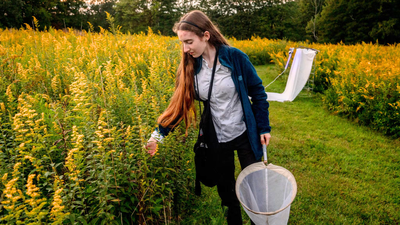
At 16, Violet Clinton has turned her fascination with insects into an ambitious scientific research project, documenting 11,377 insects during a seven-month study of moth diversity and abundance in New York. A student at Horace Greeley High School, she spends two or three evenings a week exploring the Eugene and Agnes Meyer Nature Preserve in Armonk, using ultraviolet lights, a butterfly net and homemade bait made from bananas, brown sugar and beer to attract moths. Her research examines three habitats under different weather conditions and moon phases. The project has also earned her recognition at a scientific competition, where she secured second place among college and graduate student researchers, according to a report by The New York Times.
How Violet Clinton tracked 11,377 moths in seven months
Clinton’s interest in insects began during childhood, when she regularly searched for grasshoppers and other small creatures. One of her earliest memorable encounters with moths occurred when she was about seven and brought home two woolly bear caterpillars she had found crawling along a pavement.During winter, she thought the caterpillars had died. When spring arrived, they emerged as Isabella tiger moths with distinctive orange wings. The experience deepened her curiosity about insects and their life cycles.By the summer between middle school and high school, Clinton was studying insect field guides to prepare for entomology competitions as part of her school’s Science Olympiad team. Her family supported her interest, allowing her to raise hornworms bought from a pet shop until they developed into Carolina sphinx moths.Her fascination eventually became a formal research project. At the beginning of her sophomore year, a science research course at Horace Greeley High School required students to choose a subject to investigate. While some students opted to analyse existing datasets, Clinton decided to conduct her own fieldwork.She contacted Jason J. Dombroskie, an entomologist who manages the Cornell University Insect Collection, seeking guidance on developing her project. They began meeting online in January to refine her research methods and plan her data collection.
How she attracts moths using UV lights and beer-soaked T-shirts
Clinton conducts her fieldwork after sunset, visiting three habitats: deciduous forest, pine forest and meadow. At each location, she uses different methods to attract moths and records the environmental conditions under which they appear.One technique involves ultraviolet lights positioned near a sheet of canvas. The lights attract moths, allowing her to observe and photograph them. She bought one light with money earned from her after-school job shelving books at a local library, while the other was originally intended as a Halloween decoration.She also prepares homemade bait using mushy bananas, brown sugar and beer. She soaks a T-shirt in the mixture and places it over a gardening cage to attract moths that might not gather around the lights.Her father, Brian Clinton, a physician, drives her to and from the nature preserve and buys the beer she needs for the bait. Although he accompanies her on the expeditions, he does not help collect the research data.During each outing, Clinton photographs the moths she encounters and records environmental measurements, including temperature, air pressure and humidity. She also considers weather conditions and moon phases as part of her investigation into variations in moth diversity and abundance.After photographing the insects, she releases them rather than keeping them as specimens. This approach reflects her affection for the creatures and her reluctance to harm them.
The importance of her research
Moths are among the most diverse groups of insects, yet they often receive less public attention than butterflies and bees. Clinton’s project aims to document which species inhabit the preserve and investigate how moth diversity and abundance vary across different habitats and environmental conditions.Comparing observations from deciduous woodland, pine forest and meadow can help researchers investigate differences in the species recorded in each environment. Recording weather conditions and moon phases also provides information that can help scientists interpret variations between sampling sessions.Her mentor, Dombroskie, believes the dataset could remain useful long after the project concludes. According to The New York Times, her observations may help researchers improve their understanding of moth distribution in the area, particularly among common species that have received relatively little scientific attention.Biodiversity surveys can establish a baseline against which future observations can be compared, helping scientists investigate changes in species distributions and seasonal activity. However, documenting moths alone cannot establish long-term population declines or determine how effectively individual species pollinate plants.
Clinton earned recognition among university researchers
Clinton presented preliminary findings from her research at the Lepidopterists’ Society’s annual meeting in June 2026, held at the Carnegie Museum of Natural History in Pittsburgh, Pennsylvania.The society brings together people interested in the study of butterflies and moths, including professional researchers, students and amateur naturalists. Its annual meeting provides opportunities for participants to present their work and exchange scientific knowledge.Clinton entered a student research competition with a poster outlining her preliminary findings from the three habitats. Her competitors included college and graduate students with experience in scientific research.Dombroskie initially doubted that she would win against such an experienced field of participants. Nevertheless, according to The New York Times, Clinton secured second place in the competition.The achievement brought recognition to her independent fieldwork and demonstrated how a high school student could undertake a substantial biodiversity survey with appropriate guidance.Following the completion of her fieldwork, Clinton plans to analyse her observations and submit her findings to academic journals.
The overlooked role of moths in pollination
Moths are important nocturnal pollinators, transferring pollen between flowers as they feed on nectar. A 2023 University of Sussex-led study at 10 sites in south-east England found that moths could be effective pollinators despite making fewer visits than daytime insects. Their contribution varies across plant species and environments. Moths also play a vital role in food webs, providing food for birds, bats and other insect-eating animals.As scientists investigate insect declines, studying moth diversity can help reveal changes in ecosystems. A 2021 review published in Proceedings of the National Academy of Sciences found that moth population trends vary by region and species, with declines documented in several areas. Clinton’s research could help improve understanding of moth diversity while encouraging people to appreciate these often-overlooked insects, many of which have striking colours, intricate patterns and specialised adaptations.
How digital tools help her identify moths
Photographing a moth is only the first step in Clinton’s research. She must also identify the species and organise her observations for analysis.She uses iNaturalist, a citizen-science platform that allows people to document wildlife observations and seek help identifying organisms. Other naturalists and specialists can suggest identifications, helping users distinguish between species that may look similar.Clinton also consults field guides covering moths found in the northeastern United States and online resources such as BugGuide.Identification can be challenging because some species have similar wing patterns, while others are so small that their distinguishing characteristics are difficult to see without magnification.By combining photographs, field guides and assistance from other naturalists, Clinton builds a record of her observations without having to collect and preserve every insect she encounters.
she wants to become a zoo veterinarian
Despite her enthusiasm for moths, Clinton does not plan to become a professional entomologist. One reason is that some forms of insect research involve collecting and killing specimens for examination and preservation.She is uncomfortable with the idea of killing insects for scientific purposes and prefers to photograph and release the moths she encounters.Instead, she plans to study animal science at university and pursue a career as a zoo veterinarian.Her fascination with insects continues beyond her scheduled fieldwork. The newspaper report describes how she once encountered a greater red dart moth in a school hallway, identified it and released it.Clinton planned to end her data collection in October, when the number of adult moths active in the area begins to decline. She then intended to complete her analysis and submit her findings to academic journals.