Meet Ella Lu, the 17-year-old North Carolina student who taught AI to recognise how Impressionist painters arranged objects in their paintings |
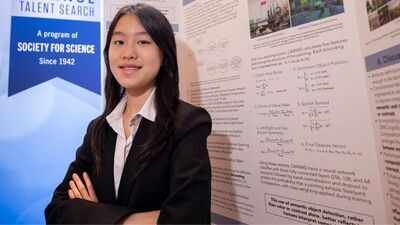
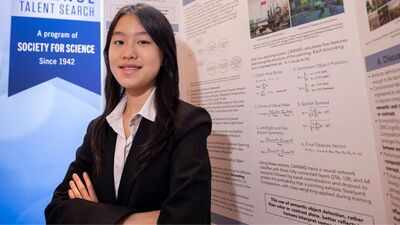
Ella Lu, a 17-year-old student from Chapel Hill, North Carolina, has found a way to bring two different interests of ‘art’ and ‘computer science’ together. As a senior at the North Carolina School of Science and Mathematics(NCSSM), Lu developed a system that can study how objects are arranged in paintings, focusing on works by impressionist artists (a painter from a 19th-century movement that started in Paris and used short, visible brush marks and bright colors to show natural light and everyday life instead of formal details).Her project is known as CANVAS (Compositional Analysis of Visual Art Structure). Instead of simply asking AI to recognise what appears in a painting, Lu wanted it to understand where visual elements are placed in the painting and how those choices create a composition. The project was inspired from her own experience as a painter and became a way to investigate whether artists use shared ideas across different works and periods.
How did Ella Lu combine art and artificial intelligence through CANVAS
Lu’s project began with a question about something artists often learn almost instinctively which is about ‘how objects should be positioned inside a picture.’ According to NCSSM, the idea emerged during Lu’s sophomore year at Chapel Hill High School. Her art teacher introduced her class to different compositional techniques that could help students improve their paintings. The lesson made Lu wonder whether artists across different periods had been making similar choices when arranging elements in their work. That curiosity eventually became the foundation for CANVAS. The Society for Science describes CANVAS as a ‘framework designed to analyse the structure of visual art.’ Instead of simply identifying individual objects in a painting, the system looks at how those elements are positioned in relation to one another. The NCSSM reported that she described the research as a way of ‘bridging’ her love of art with her interest in computation, STEM and science.
What was Lu trying to teach the AI to recognise
One of the main ideas Lu investigated was a technique known as ‘steelyard composition.’ The Society for Science explains that this approach involves balancing a large, attention-grabbing element on one side of an artwork with smaller elements on the other. The arrangement can create a sense of visual balance even though the objects themselves may differ greatly in size. For a human viewer, recognising such a pattern can feel almost automatic. A person looking at a painting may notice that one large object dominates one side while several smaller objects balance it elsewhere without consciously measuring the arrangement.A computer, however, needs much more explicit information. Lu therefore manually examined paintings in a large public dataset of Impressionist landscape artworks. She identified examples containing steelyard composition and other techniques. This human-labelled information then became part of the material used to train her AI model. This approach allowed Lu to turn something that artists and viewers can recognise visually into information that a computer could analyse.

Ella attends North Carolina School of Science and Mathematics (Durham). Image Credit: Chris Ayers/Society for Science
How did CANVAS learn from Impressionist paintings
Lu did not build the entire system from scratch. The Society for Science says she used Grounding DINO, an existing AI tool designed to help computers recognise objects within images. She combined this tool with the information she had gathered manually from Impressionist paintings. Together, these components helped CANVAS identify examples of steelyard composition. The distinction is important because Lu’s project was not simply about teaching a computer that a painting contains a tree, person, building or other object. The larger goal was to examine the relationship between those objects and their positions within the artwork. That gives the project a different direction from ordinary image recognition. It asks AI to look beyond what is shown and consider ‘how’ the visual elements have been arranged. The Society for Science says this could eventually support large-scale analysis of art and help machines understand aspects of artworks that humans can often grasp intuitively.
Lu’s project stood out in the Regeneron Science Talent Search
The project earned Lu a place among the ‘40 finalists of the 2026 Regeneron Science Talent Search.’ The Society for Science reported that the finalists were selected from 300 scholars and 2,612 entrants, making it the largest pool of applicants to the competition since 1967. The finalists represented 35 schools across 15 states and were competing for more than $1.8 million in awards, including a top prize of $250,000.NCSSM reported that Lu was already among the competition’s 300 Scholars before learning she had reached the Top 40. The news came through an unexpected phone call while she was waiting at Raleigh-Durham airport to begin a school trip to Buenos Aires. Lu initially thought the call might concern a problem with her project. Instead, she was told that she had become one of the finalists. NCSSM noted that around 2,600 students had entered their research in the competition.
Hobbies and interests of Lu beyond her research
Lu’s interests extend well beyond computer science. The Society for Science reports that she serves as co-president of her school’s ‘Girls Who Code Club,’ where she develops and leads weekly lessons in Python. She is also editor-in-chief of ‘Blue Mirror,’ the school’s literary arts magazine. She also plays piano and guitar. Those interests help explain why her research feels closely connected to her own life rather than being an isolated computer science exercise. She began with something she encountered as a painter and then used programming to explore the question from another direction.
Could AI help researchers study art on a larger scale
Lu’s work points towards one possible way of using AI in the examining of patterns across large collections of paintings. Human researchers can study individual artworks in great detail, but analysing thousands of pieces manually can take considerable time. A system such as CANVAS could potentially help researchers examine recurring compositional patterns across much larger collections. The Society for Science says Lu’s work may help machines understand art in ways that are closer to human visual understanding while supporting large-scale analysis. Lu’s research became the meeting point between painting and programming, showing how a teenager’s curiosity about arranging objects on a canvas can become a serious scientific investigation into how computers understand visual art.