Karwa Chauth 2026: Date, Puja Muhurat, Moonrise Time, Vrat Katha and Complete Fasting Guide

The Hindu month of Kartik has arrived, and with it the most awaited fast of the year for married women in North India. Karwa Chauth this year falls on Thursday, 29 October 2026. The day asks for discipline from dawn to moonrise. But it also carries one of the most loved stories in the Hindu calendar, along with rituals that families have passed down for generations.
Karwa Chauth 2026 Date and Tithi
The festival is kept on Chaturthi of Krishna Paksha in Kartik month. In 2026, this tithi starts at 1:06 AM on Thursday and runs till 10:09 PM that night.Karwa Chauth follows a clear principle. The Chaturthi must be present when the Moon rises, since the vrat closes with Chandra puja. Wednesday evening still has Tritiya at moonrise, so it does not qualify. Thursday holds Chaturthi through the whole evening. That fixes 29 October as the vrat date across India.For Indians living in North America, the date moves to Wednesday, 28 October, because of the time zone gap.
Puja Muhurat, Fasting Hours and Moonrise
Here are the key timings for Delhi NCR:·Fast begins: 6:31 AM (sunrise)Puja Muhurat: 5:38 PM to 6:56 PMMoonrise: around 8:17 PMThe evening muhurat lasts 1 hour 17 minutes and sits within Pradosh Kaal. Moonrise varies with location. Cities in the east, like Kolkata and Guwahati, will see the Moon well before Delhi. Those in the west, like Jaipur, Ahmedabad and Mumbai, will wait longer. Women outside NCR should confirm the local time a day ahead.
Who Is Worshipped on Karwa Chauth
The central deity is Karva Mata, a form of Goddess Parvati linked with marital bliss. Lord Shiva is worshipped with her, and so are Ganesha and Kartikeya. Chaturthi is Lord Ganesha’s tithi, so he is offered the first prayer. The Moon receives the final arghya.In Vedic astrology, Chandra rules the mind, emotions and the bond of care between two people. Worship of the Moon on Kartik Krishna Chaturthi is meant to bring peace into married life and to protect the health and longevity of the husband.
Karwa Chauth Vrat Katha : The Story of Veervati
Long ago, a woman named Veervati lived with her parents and seven brothers. She was their only sister, and the brothers adored her. After her marriage, she came to her parents’ house for her first Karwa Chauth.She kept the fast without food or water. By evening, hunger and thirst had made her weak, and she fainted. The brothers could not bear to see her suffer. So they lit a fire behind a pipal tree and held a sieve in front of it. From a distance, the glow looked like the rising Moon.They told Veervati the Moon was out. She believed them, offered arghya to the false Moon and ate her first bite. Soon after, a message arrived that her husband had died.Veervati was shattered. She refused to accept his death and sat beside his body through the year, praying without pause. Goddess Parvati, moved by her devotion, told her that the fast had been broken before true moonrise. She advised Veervati to keep every Chaturthi vrat that year and to observe the next Karwa Chauth with complete faith.Veervati did so. When the next Karwa Chauth came and she finished the vrat properly, her husband’s life was restored.The story is read during the evening puja every year. Its lesson is simple. The fast is complete only when the real Moon is seen.
Complete Fasting Guide
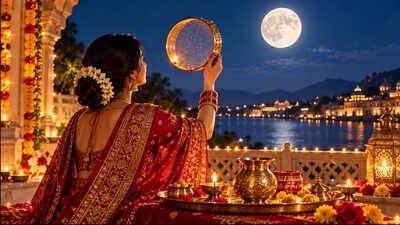
Before dawn: Wake early and eat the sargi sent by the mother-in-law. It usually includes dry fruits, pheni or kheer, fruits and mathri. Drink enough water at this time, since most women observe the fast without it during the day.Through the day: Avoid heavy work and long travel. Rest in the afternoon if possible. Many women apply mehendi a day earlier and dress in red, maroon or other bridal shades on the evening of the vrat. Solah shringar is traditional, but simple and clean attire is equally acceptable.Puja preparation: Arrange the thali with roli, rice, a diya, sweets, water in the karwa and a chalni. Draw or place an image of Karva Mata on the wall or a wooden plank.During the muhurat: Light the lamp, offer prayers to Ganesha first and then to Karva Mata with Shiva and Parvati. Listen to the katha. Women sitting in a group pass their thalis around seven times while singing traditional songs.At moonrise: Look at the Moon through the chalni and offer water from the karwa. Then look at your husband through the same chalni. He gives the first sip of water and a sweet to close the vrat. A light dinner should follow, not a heavy meal on an empty stomach.Health note: Pregnant women, new mothers, diabetic women and those on regular medicine should not keep a nirjala fast. Elders across traditions allow fruits, milk or water in such cases, and the vrat holds full merit with sincere prayer.