James Webb Telescope spots rare “buckyballs” around a dying star and scientists are puzzled |
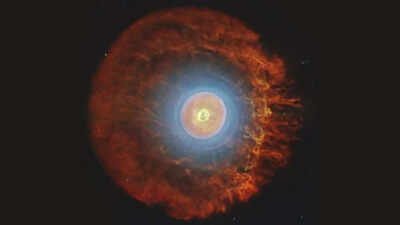
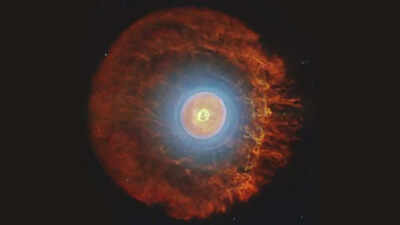
The James Webb Space Telescope has been observing a distant planetary nebula called Tc 1, and the latest images have added fresh detail to something scientists have been trying to understand for years. The object sits about 10,000 light-years away in the constellation Ara. It is the remnant of a star similar in size to our Sun, now in its final stage of life. The star has already shed its outer layers into space, leaving behind a hot white dwarf at the centre. Around it, glowing gas continues to expand slowly into the surrounding darkness.What makes Tc 1 particularly interesting is not just the dying star itself, but what is found within its surrounding cloud.
James Webb Space Telescope captures Tc 1 planetary nebula structure in dying star evolution
The structure of Tc 1 is typical of what astronomers call a planetary nebula. The name is historical and has nothing to do with planets. Early telescopes saw these objects as round, planet-like discs, which led to the term. In reality, they are the final visible stage of medium-sized stars. As the star runs out of fuel, it begins shedding layers of gas. These layers drift outward over thousands of years. The exposed core becomes a white dwarf, which continues to emit strong ultraviolet radiation. That radiation causes the surrounding gas to glow.The James Webb Space Telescope has captured this process in mid-infrared light, revealing fine structures that were not visible before. The gas does not appear smooth. Instead, it shows layers, knots, and uneven shapes that suggest complex movement and chemistry.
Buckyballs detected in expanding nebula
Inside this expanding cloud, scientists have detected carbon molecules known as buckyballs. Their formal chemical name is buckminsterfullerene. These are spherical molecules made of 60 carbon atoms arranged in a structure that resembles a football.They were first confirmed in space more than a decade ago using earlier infrared telescopes. Since then, they have been found in a small number of cosmic environments. Tc 1 was one of the first places where they were clearly identified.The latest JWST observations show them again, but with much greater clarity. The molecules appear to be arranged in a shell-like pattern around the central white dwarf. This distribution is unusual and not fully explained yet. It suggests that local conditions in the nebula may influence how these molecules form or survive.Scientists have described the arrangement as something like a structure within a structure. It is not yet clear why the molecules concentrate in this way instead of being spread evenly through the gas.
Unusual nebula features and puzzling carbon
The nebula also shows other unusual features. One of the most noticeable is a faint structure that resembles an upside-down question mark. It is not confirmed what created this shape, and it remains under investigation. Another puzzling detail comes from the way the buckyballs emit infrared light. The signals detected by JWST do not fully match theoretical predictions. That means current models of how these molecules respond to radiation may be incomplete.