In the 1960s a Montana landowner bought 2 mute swans for private pond. Decades later their flock reached 120; alarming Yellowstone officials |
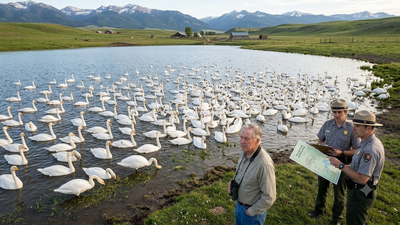
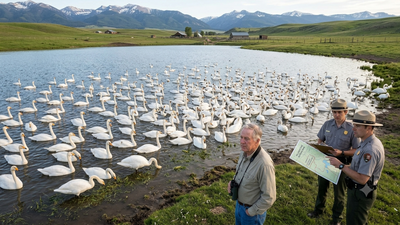
A pair of ornamental swans bought for a private pond in Montana in the 1960s eventually became the starting point for a very different kind of wildlife story. By the late 1970s, the flock in Paradise Valley had grown to 120, drawing the attention of Yellowstone National Park officials concerned about possible competition with native trumpeter swans. The birds had been introduced for their beauty, but their rapid expansion changed how they were viewed. Paradise Valley, north of Yellowstone, was also an important area for trumpeter swans, whose numbers were already a conservation concern. In 1987, Yellowstone staff began working with local landowners on a plan to remove the introduced birds and replace them with captive-raised trumpeter swans. What followed was a gradual shift: by 1989, only 13 mute swans remained, and by the mid-1990s they had disappeared from the valley altogether. The episode showed how a small private decision could eventually reshape a much larger conservation effort.
Two ornamental swans became a flock of 120 in just over a decade
Mute swans have a long history of being kept for ornamental purposes. Their large size and white plumage made them popular additions to estates, ponds and other private properties in North America, even though the species is native to parts of Europe and Asia rather than the American West.According to Yellowstone Bird Report, in Paradise Valley, two such birds were brought onto private land during the 1960s. Their numbers changed quickly. Within little more than a decade, the original pair had produced a flock estimated at around 120 birds.
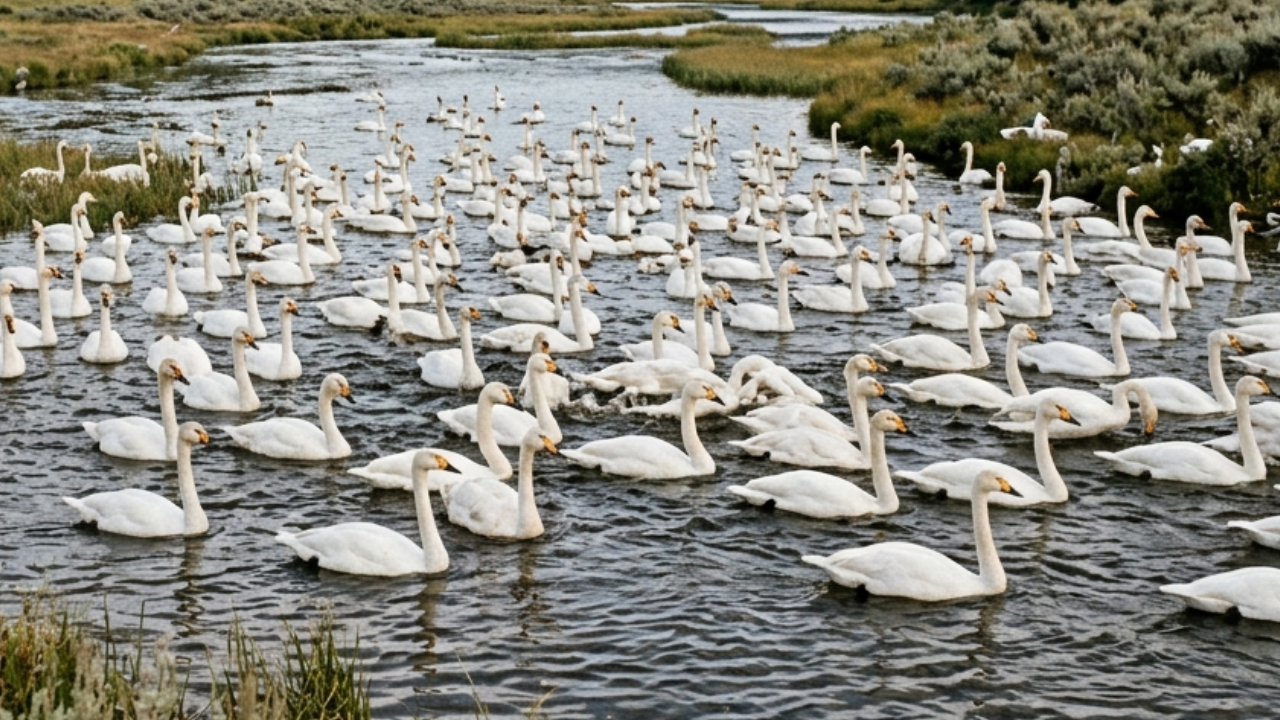
That growth put the swans in a different category from decorative birds kept on a private pond. Paradise Valley sits along the Yellowstone River corridor, north of Yellowstone National Park, and native trumpeter swans were using the same broader landscape.The two species were not identical in how they behaved, either. Mute swans can be highly territorial, particularly when nesting or raising young. For wildlife managers, a growing population therefore raised questions about whether the introduced birds might take over areas that were also useful to trumpeter swans.
Yellowstone officials turned to landowners for a solution
The National Park Service’s interest was tied to the presence and recovery of trumpeter swans, rather than simply an attempt to remove birds from private land. Officials were concerned about the possibility of competition between the introduced mute swans and the native species.The land where many of the birds lived was privately owned, so the response could not simply be treated as a routine operation inside Yellowstone National Park.By 1987, Yellowstone staff had developed a proposal for Paradise Valley landowners who were interested in supporting trumpeter swans. The idea was to remove the mute swans and establish captive-raised trumpeter swans in their place.It was a cooperative arrangement rather than a straightforward government operation. Landowners took part, while Yellowstone personnel helped organise and carry out the work.
Yellowstone’s swan removal took years rather than a single sweep
The removal effort began in autumn 1987, with Yellowstone’s staff ornithologist working alongside park rangers and participating landowners. Funding came from outside the park as well. The Cinnabar Foundation and Chevron Corporation provided financial support, while private individuals also contributed.The birds were not removed in a single sweep. The population declined gradually.By 1989, only 13 mute swans were recorded in the area. That same period also saw the arrival of captive-raised trumpeter swans, beginning the second part of the project.The objective was not to maintain the original number of swans by replacing every mute swan with a trumpeter. Instead, the programme sought to remove an introduced species while giving the native species an opportunity to establish a population of its own. According to 2001 records, nine trumpeter swans and two remaining mute swans in Paradise Valley were recorded in 1991. By the middle of the decade, the mute swans had disappeared from the valley.
The flock faced dangers even after the introduced swans disappeared
Getting rid of the mute swans was only one part of the story. The trumpeter swans that followed faced their own problems.In December 1995, three swans at the DePuy Ranch were illegally shot. Two were captive birds and one was wild. The incident reduced the flock at a time when the replacement population was still being established.Then came two difficult years along the Yellowstone River. Severe flooding in 1997 and again in 1998 pushed many swans downstream, causing a substantial decline in the flock. Further adult deaths were recorded in the years that followed.So the population did not simply climb steadily after the mute swans were removed. There were losses, disruptions and periods when the number of birds fell.
What started with two ornamental birds ended with a conservation comeback
Despite those setbacks, the trumpeter swans continued to reproduce and become established in the valley. By 2005, Yellowstone Bird Report records listed 24 trumpeter swans in Paradise Valley: 17 captive adults and seven wild swans or cygnets. Three nesting pairs produced seven young across two broods that year.The birds were not confined to the valley, either. Banded trumpeter swans originating from Paradise Valley had been seen within Yellowstone National Park, providing evidence that some of the birds were moving through the wider region.