In 2026, scientists gave bumblebees a puzzle they had never seen before; some invented their own way to reach a hidden reward |
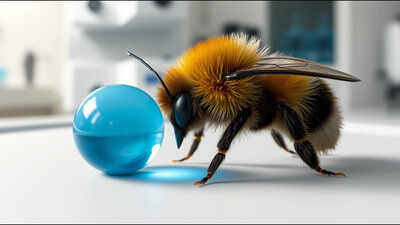
More than a century ago, psychologist Wolfgang Köhler conducted experiments that changed how scientists thought about animal intelligence. In one of his best-known demonstrations, chimpanzees were faced with food placed out of reach and objects they could potentially use to obtain it. Rather than simply repeating familiar actions, some animals appeared to recognise how the objects could be combined to solve a problem they had not previously encountered. The experiments became a classic example of insight-like problem solving, a behaviour often associated with animals possessing relatively large and complex brains. Now, researchers from the University of Oulu, the University of Helsinki and the University of Turku in Finland have found surprisingly flexible problem solving in an animal with a brain tiny by comparison: the bumblebee. The insects were given an unfamiliar task involving a ball and a reward, without being shown how the two were connected. Some bees eventually discovered that they could move the ball to a particular location and use it to reach the reward, suggesting that insects can combine previously learned information to solve a completely new physical problem.
How bumble bees rolled a ball to reach a reward they had never been taught to find
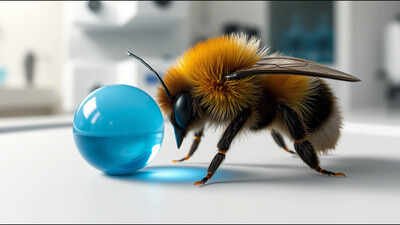
The experiment used bumble bees belonging to the species Bombus terrestris. Researchers first taught the insects that a blue artificial flower was associated with a food reward. The bees therefore had a clear reason to seek out the flower, but they were not taught how to reach it when its position was changed. Researchers then placed the blue flower on the ceiling of a transparent experimental arena, where it was physically beyond the bees’ reach. On the floor below it, they placed small balls that the insects could move. The solution required several steps. A bee had to interact with one of the balls, push or roll it across the arena, move it underneath the flower and then climb onto the ball to get closer to the reward. Crucially, the bees had not been trained to carry out that sequence. They had experience with the rewarded flower and with the movable objects, but researchers had not demonstrated that moving the ball beneath the flower would allow them to reach the food. Senior author Olli Loukola, now a senior researcher at the University of Turku, described the experiment as essentially an insect version of Köhler’s classic problem-solving experiments. The comparison is not that bees have the same mental abilities as chimpanzees, but that both experiments ask whether an animal can use familiar elements in an unfamiliar combination to achieve a goal.
Why researchers designed controls to test whether the bees were really solving the problem
The researchers needed to distinguish genuine goal-directed behaviour from simple trial and error. A bee pushing a ball around an arena could eventually put it in the right place by chance, particularly if it had enough opportunities to repeat the behaviour. The experiment therefore compared the behaviour of bees that successfully solved the task with those that did not. The successful bees showed more directed movements and were more likely to move the ball towards the location required to reach the reward. Researchers also conducted trials designed to remove another possible explanation: that the insects were simply following the visible flower while moving the ball. In these tests, the reward was hidden from view while the bee was manipulating the ball. Even without being able to see the flower during the movement, successful bees continued to move the ball towards the appropriate location. That finding suggested that the insects were not simply pushing the object towards something visually attractive. Instead, they appeared to retain information about where the goal was and use that information while manipulating the ball.
Why watching the bees solve the puzzle surprised the researchers
The researchers were also interested in what the problem-solving process looked like in real time. According to co-author Ece Nur Akmeşe of the University of Helsinki, some bees initially appeared to explore the arena without an obvious strategy. Their behaviour could then change, with an individual suddenly becoming much more directed and beginning to move the ball towards the required position. That change is particularly interesting because it does not look like a bee simply repeating an action it has already been trained to perform. Bumble bees are already known to be capable of learning and adapting in ways that were once considered surprisingly sophisticated for insects. Previous experiments have shown that they can learn from other bees, remember useful information, manipulate objects and modify their behaviour when circumstances change. The new experiment goes a step further by deliberately presenting the insects with a problem for which the complete solution had never been demonstrated. The researchers are not suggesting that bees experience a conscious “eureka” moment identical to a human or chimpanzee. Instead, the important finding is behavioural: some insects were able to discover an effective solution to a novel physical problem using information they had previously learned.
Why the findings change how scientists think about intelligence
The study does not show that bumble bees think like humans, nor does it establish that they possess human-like consciousness. Loukola has been careful to make that distinction. What the researchers have demonstrated is that complex and flexible behaviour can emerge from a nervous system vastly smaller than those found in the animals traditionally associated with insight and problem solving. That matters because intelligence has often been studied through the abilities of animals such as primates, birds and other vertebrates. Their relatively large brains have made them natural subjects for experiments involving memory, planning, tool use and problem solving. Insects, by contrast, have sometimes been treated as creatures primarily driven by relatively simple instincts and learned associations. Research over the past several years has increasingly challenged that picture. Bees can learn surprisingly complicated tasks and retain information about their surroundings, and the new findings suggest that they can also use those abilities in combination when faced with something unfamiliar.The study, titled Spontaneous problem-solving in bumble bees, was published in Science on June 4, 2026. Its significance lies less in suggesting that bees are miniature versions of humans and more in showing that sophisticated behavioural flexibility does not necessarily require a large brain. A bumblebee has only a tiny fraction of the neural machinery found in a chimpanzee, yet it can still learn about objects, remember goals and manipulate its environment in pursuit of a reward. The experiment therefore leaves scientists with a broader question about intelligence: perhaps there is no single neurological blueprint required for solving new problems. Different animals may arrive at flexible solutions using very different kinds of brains. The bees did not understand Köhler’s famous box-and-banana experiment, and they were not imitating human reasoning. But when presented with a problem they had never been taught to solve, some of them nevertheless found their own way to the answer.