In 2016, scientists tested drone-dropped peanut-butter vaccine baits to protect prairie dogs and save North America’s rarest mammal |
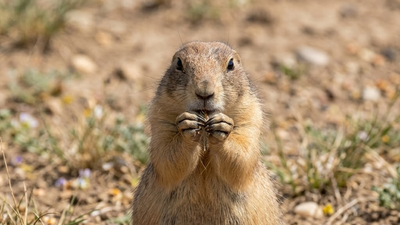
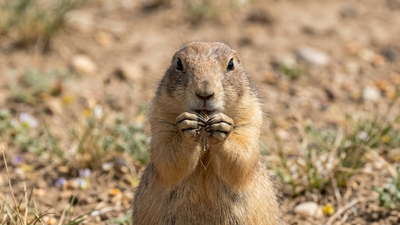
The black-footed ferret is North America’s rarest mammal, with only about 300 estimated to survive in the wild at the end of 2015. The species has been listed as endangered since 1967, and its survival is closely tied to prairie dogs, which provide almost all of its food as well as the burrow systems the ferrets use for shelter. That dependence became a serious liability when sylvatic plague, a non-native bacterial disease spread by fleas, began devastating prairie-dog colonies. Researchers therefore developed an oral plague vaccine hidden inside small, peanut-butter-flavoured baits that prairie dogs could eat. To distribute those baits across huge areas of remote prairie, scientists began testing unmanned aircraft equipped with automated dispensers. In 2016, researchers tested a drone delivery system alongside two ground-based mechanisms at Montana’s U.L. Bend National Wildlife Refuge, exploring whether an unconventional combination of wildlife medicine and aerial technology could eventually make large-scale plague control more practical.
Why prairie-dog colonies collapsing from plague put endangered ferrets at risk
Sylvatic plague is not native to North America, and prairie dogs are highly susceptible to the disease. An outbreak can rapidly devastate or eliminate prairie-dog colonies, creating a serious problem for black-footed ferrets because the animals depend on prairie dogs for both food and the burrow systems they use for shelter.For years, one way researchers fought the disease was by applying insecticide to prairie-dog burrows to kill the fleas that transmit plague. But treating large colonies this way is labour-intensive and difficult to repeat across vast areas of grassland. Researchers therefore began looking for a way to protect prairie dogs directly rather than relying entirely on controlling the fleas that spread the disease.
How scientists developed and tested a vaccine delivery system at U.L. Bend
Researchers at the USGS National Wildlife Health Centre and the University of Wisconsin spent much of the 2000s developing and laboratory-testing an oral vaccine designed to protect prairie dogs against plague. Field studies followed, including trials in which researchers distributed vaccine baits by hand across 50-acre test plots.The researchers then began developing mechanised ways to distribute the baits over larger areas. By 2016, they had three prototype systems: an unmanned aerial drone that dropped individual baits, an all-terrain vehicle that dropped individual baits, and an ATV-mounted device capable of dispensing three baits at once. In August 2016, the three systems were tested across about 1,200 acres of prairie-dog colonies at U.L. Bend National Wildlife Refuge in Montana. The refuge had been one of the sites where captive-bred black-footed ferrets were reintroduced beginning in 1994.
What was inside the peanut-butter vaccine pellets
The vaccine baits were deliberately designed to appeal to prairie dogs. They used a peanut-butter flavour and were colored blue, making them visible to the animals. Earlier field experiments reported bait consumption rates of roughly 70 to 95 per cent in treated areas, while a later large-scale study involving 7,820 prairie dogs found an overall uptake rate of about 70 per cent.The delivery problem was just as important as getting prairie dogs to eat the vaccine. Federal assessments estimated that a person distributing baits along predetermined routes could cover roughly 3 to 6 acres per hour. A suitably equipped drone, by comparison, was projected to cover substantially more ground, with estimates reaching about 200 acres per hour for a system capable of dispensing three baits simultaneously. That 200-acre figure was a projected capability, however, rather than a demonstrated sustained speed during the 2016 field trial.
What the drone experiment could mean for black-footed ferret recovery
The 2016 experiment showed that mechanized systems could make vaccine-bait distribution considerably less labor-intensive, but researchers did not present the drones as a finished solution to plague. The U.S. Fish and Wildlife Service said additional research was needed to determine whether large-scale vaccination could maintain prairie-dog colonies capable of supporting healthy black-footed ferret populations.The idea was therefore less about vaccinating ferrets directly and more about protecting the ecosystem they depend on. If enough prairie dogs survived plague outbreaks, the reasoning went, their colonies could continue providing both prey and shelter for black-footed ferrets. Subsequent fieldwork continued testing different ways of distributing the vaccine, including aerial and ground-based systems.What makes the approach unusual is also what makes it potentially useful: instead of trying to catch endangered ferrets one by one, researchers were targeting a disease in the prairie-dog populations that sustain them. The combination of an oral vaccine, an appealing peanut-butter bait and automated delivery offered a way to tackle a disease problem across landscapes far too large to treat efficiently by hand.