
Human Brain Vs AI: Your brain runs on less power than a light bulb, outperforming supercomputers, yet AI needs entire data centres to compete |
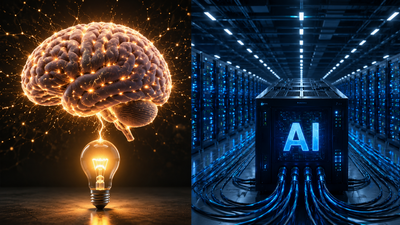
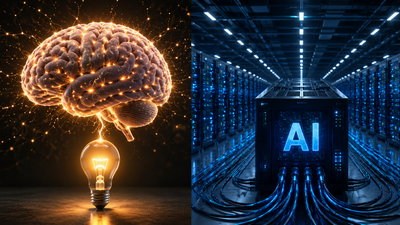
Every thought you have, every face you recognise and every memory you recall is powered by an organ that consumes roughly the same amount of electricity as a dim light bulb. The human brain operates on about 20 watts of power, yet it performs tasks that continue to challenge some of the world’s most advanced artificial intelligence systems. As AI companies spend billions building energy-hungry data centres packed with powerful chips, neuroscientists and computer engineers are increasingly looking to the brain itself for inspiration. The comparison reveals one of the most remarkable feats of nature: an energy-efficient biological computer refined by millions of years of evolution.
Human Brain Vs AI : Why a 20-watt brain remains the ultimate supercomputer
The human brain weighs about 1.4 kilograms and accounts for only around 2% of body weight. Yet it contains roughly 86 billion neurons, according to a landmark 2009 study led by Brazilian neuroscientist Suzana Herculano-Houzel and published in The Journal of Comparative Neurology. These neurons are linked by an estimated 100 trillion synapses, creating one of the most complex information-processing systems known to science.Despite this staggering complexity, the brain operates on only about 20 watts of power, roughly the same amount of electricity consumed by a dim light bulb. In 2023, researchers from the Human Brain Project and associated neuromorphic computing programmes highlighted the scale of this efficiency gap. Their analysis estimated that a detailed emulation of the human brain on conventional digital hardware could require as much as 2.7 gigawatts of power, compared with the brain’s roughly 20-watt energy budget.The researchers argued that the brain achieves this extraordinary efficiency through sparse neural firing, analogue-style signalling and massive parallel processing. Most neurons remain inactive at any given moment and fire only when needed, conserving energy. Unlike conventional computers, which separate memory from processing and constantly move data between the two, the brain integrates both functions within the same neural networks, reducing energy costs while increasing efficiency.These findings have strengthened interest in neuromorphic computing, a field pioneered by California Institute of Technology engineer Carver Mead. Research programmes at IBM Research and Intel Labs have developed experimental chips such as TrueNorth and Loihi that mimic aspects of biological neural networks. Their work comes as the International Energy Agency reported that global data centres consumed an estimated 415 terawatt-hours of electricity in 2024, underscoring the growing challenge of powering the AI revolution.
AI’s growing power problem
The brain’s efficiency has become increasingly relevant as artificial intelligence expands.Large AI models require enormous computational resources for training and operation. Data centres worldwide consumed an estimated 415 terawatt-hours of electricity in 2024, with AI becoming a major driver of growing demand. Every time a user generates an image, asks a chatbot a question or runs an advanced AI model, thousands of processors may be involved behind the scenes.Scientists and industry leaders have begun to worry that energy demand could become one of the biggest constraints on future AI development.“The future of AI may depend as much on efficiency as intelligence,” many researchers now argue.
Can computers learn from the brain?
To address this challenge, engineers are developing a field known as neuromorphic computing. Rather than forcing AI to run on conventional processors, neuromorphic systems attempt to mimic how biological neurons communicate.Among the best-known projects is IBM’s TrueNorth chip, which was designed to emulate neural networks while consuming a fraction of the energy used by traditional hardware. Intel later developed its Loihi and Loihi 2 neuromorphic processors, which use artificial neurons that communicate through event-driven spikes resembling those found in biological brains.Research continues to show promising results. Studies involving Intel’s Loihi platform have demonstrated substantial energy savings compared with conventional AI approaches. In some experimental applications, neuromorphic systems have achieved comparable performance while consuming dramatically less energy.
The gap remains enormous
Despite rapid progress, no existing machine comes close to matching the human brain’s combination of efficiency, adaptability and general intelligence.The largest neuromorphic systems contain billions of artificial neurons, impressive by engineering standards but still far below the scale and sophistication of the human brain. Scientists also continue to debate how consciousness, memory and learning emerge from neural activity, meaning many of the brain’s most important secrets remain unsolved.Dr. Kwabena Boahen of Stanford University, another leading figure in neuromorphic engineering, has often described the brain as a masterclass in efficient computation. Understanding its principles, researchers believe, could transform everything from robotics and medical devices to future AI systems.
Nature’s engineering masterpiece
The comparison between the human brain and AI is not really a contest of intelligence. Today’s AI can already outperform humans in narrow tasks such as chess, protein folding and large-scale data analysis. Yet when energy efficiency is considered, the brain remains in a league of its own.A system powered by a banana and a sandwich can recognise a friend’s face, learn a new language, navigate a crowded street and generate original ideas. Replicating those abilities with current technology requires massive infrastructure, vast amounts of electricity and some of the most powerful computers ever built.For all the excitement surrounding artificial intelligence, the most efficient known computing system is still the one sitting inside every human skull.