
Cheap import, uneven demand slowing capex


NEW DELHI: Uneven demand, commodity price volatility, trade related uncertainty due to heightened geopolitical tensions and cheap imports are impacting capex decisions of the corporate sector as the investment confidence is still “catching up”, said a paper prepared for the two-day banking conclave this week, which was attended by FM Nirmala Sitharaman.“Large capital projects require confidence not only in current demand but also in future cash flow visibility. When pricing, input costs and end-market demand remain uncertain, companies often choose to defer investment,” the paper prepared by SBI Caps said as it explained the reasons for low private capex seen in recent years.It said while most large companies today possess both the borrowing capability and internal resources required for expansion, the question is whether management teams are “sufficiently confident”.
‘Investment Confidence Still Catching Up Due To Commodity Price Volatility, Uncertainty’
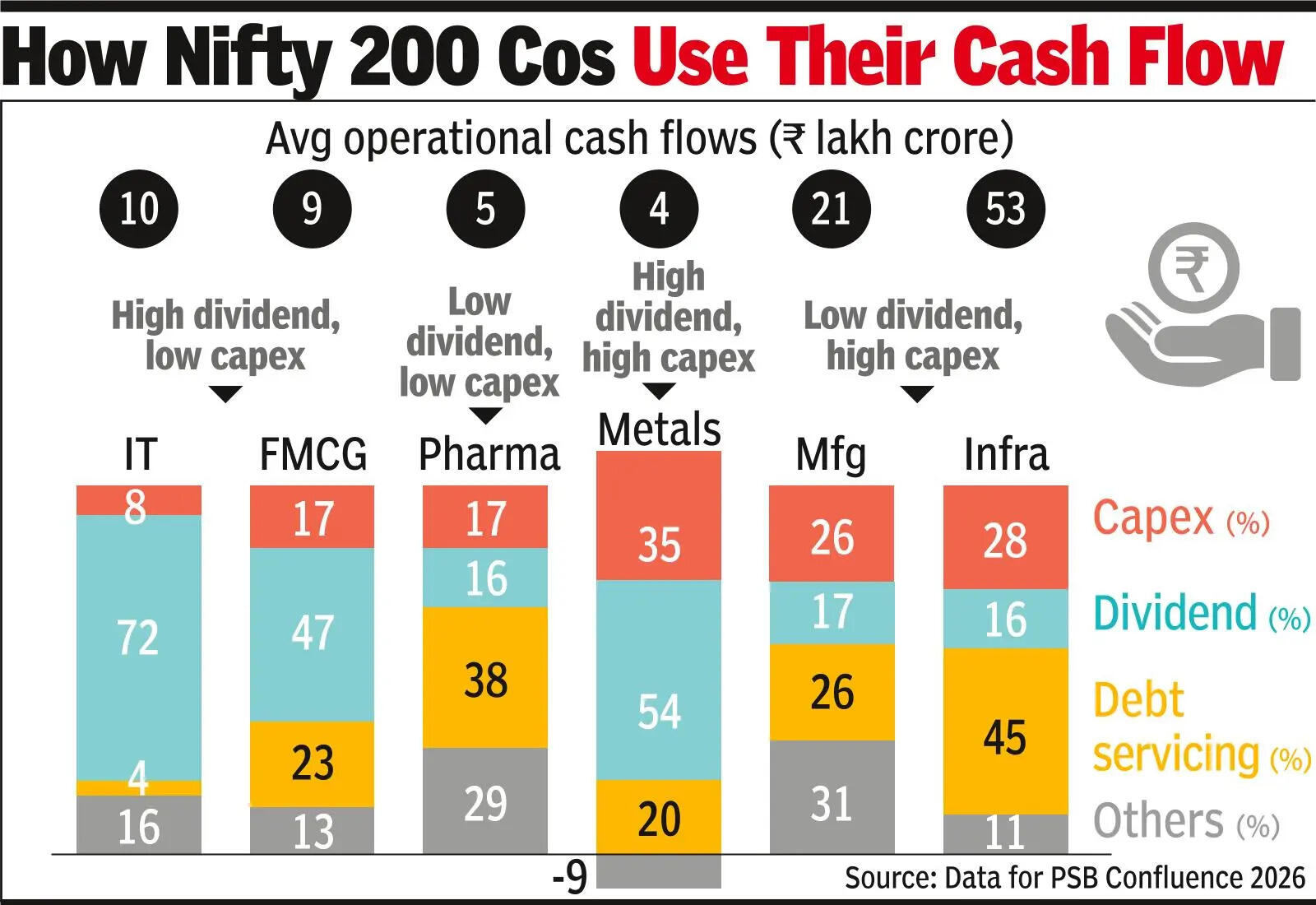
For the next investment cycle spanning over FY27- FY31, which will see average annual expenditure demand rise to Rs 30 lakh crore from approx Rs 20 lakh crore during FY22 to FY26, the paper highlighted how demand for funds will be “uneven”, based on an analysis of the current cash deployment by NSE 200 companies. “Many companies have prioritised dividends, acquisitions and retaining on balance sheets over greenfield expansion,” it said.While sectors, such as IT and FMCG are prioritising dividends; manufacturing and infrastructure are high capex sectors with low dividends. Metals is a high capex and high dividend sector, while pharma is seen to be a low dividend, low capex sector (see graphic).“Capital deployment is expected to remain concentrated in sectors where structural demand growth, policy support and capacity constraints create a compelling case for fresh investments,” it said.It also said that for the next phase of private capex cycle, sustained public sector investment continues to provide an important foundation, as govt spending on transport, power, logistics and urban infra is creating demand for private suppliers, while improving the infra required for broader industrial growth. The investment opportunities are emerging from sectors, such as semiconductors, advanced manufacturing, data centres and other tech led sectors.The paper also noted that though banks are expected to remain the dominant funding source, sustaining the next phase of growth will require a broader financing ecosystem as bank balance sheets are increasingly likely to not support the future financing requirements. The debt capital markets, securitisation structures, alternative investment funds, pension and insurance capital, infrastructure investment trusts and foreign investors will need to play a “larger role” than they do today as banks will be able to finance roughly 70% of the projected Rs 85 lakh crore external funding over FY27- FY31.The paper also recommended a few actionable inputs to be completed in the next six months by banks to support the upcoming investment rush. This includes developing a pipeline for bankable projects by establishing a screening framework and fast tracking environmental clearances. It also suggested deepening debt capital markets by mobilising capital through institutional investors like EPFO, as well as insurance companies.