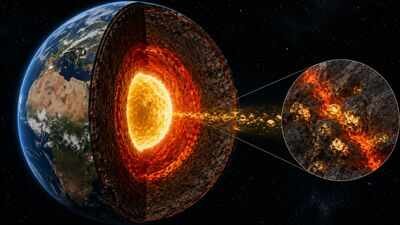
Earth’s core contains most of the planet’s gold, and scientists now find evidence that some core material is leaking into the mantle |

Earth’s core holds far more gold than anyone can reach. More than 99.999 per cent of the planet’s stores of gold and other precious metals lie buried under 3,000 kilometres of solid rock, locked away within the metallic core and far beyond the reach of humankind. For decades, geologists assumed this vast reserve was permanently…
Read More

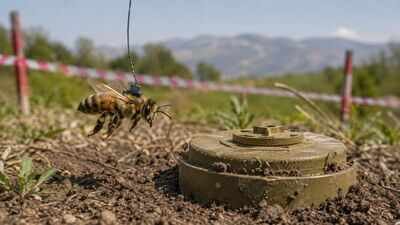
In 2013, honeybees were trained to find land mines left behind by the Balkan wars, turning their extraordinary sense of smell into an unlikely detection tool |

Croatia was still dealing with the hidden legacy of the Balkan wars when scientists began looking to an unlikely ally: honeybees. Years after mines had been buried across fields, forests and rural land, uncertainty over their locations continued to complicate farming, development and everyday life. Traditional mine-clearance teams faced the difficult task of finding explosives…

Read More

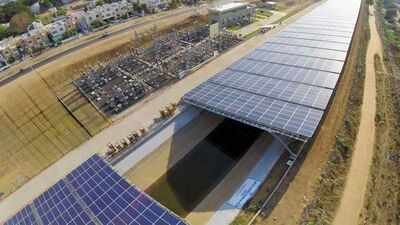
A half-mile solar strip floats above an irrigation canal in Gujarat, generating 1.6 million kilowatt-hours of power while saving 2.38 million gallons of water from evaporation

When it comes to solar panels, they are usually spread across rooftops or open fields where they serve more purposes than just providing energy. But near Chandrasan village in the western Indian state of Gujarat, a roughly 2,460-foot ribbon of panels sits above moving irrigation water, turning an existing canal into both a power site…

Read More

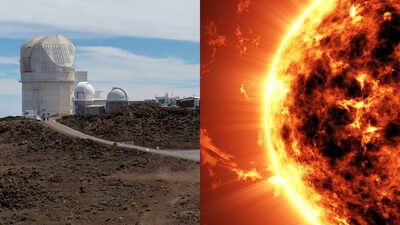
The world’s largest solar telescope resolved the Sun at about 19-km scale and revealed ubiquitous plasma vortices that may help explain how magnetic energy moves

The observations were made with the Daniel K. Inouye Solar Telescope (DKIST), a powerful 4-metre class solar telescope operated by the US National Science Foundation. The Sun may appear to us on Earth as a glowing ball of plasma, but its surface is far more active and turbulent than it looks, which has been proven…

Read More

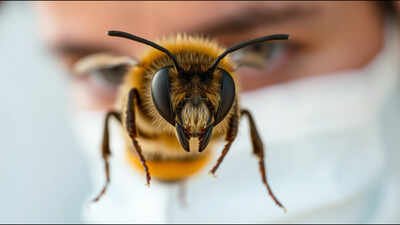
Scientists trained honeybees to recognise human faces, showing how tiny brains can distinguish faces by the arrangement of their features |

Honeybees can be trained with nothing more than the promise of a sugary reward; they learn to pick out a specific face and keep picking it out later, even when it appears from a slightly different angle or sits among faces they have never encountered before. It is a strange and slightly humbling discovery, not…

Read More

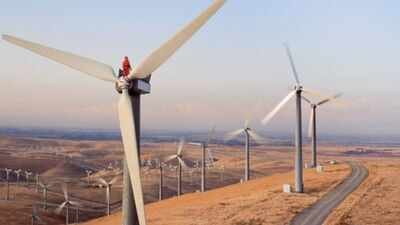
Wyoming’s Casper landfill buried 1,124 turbine blades after each was cut into three pieces; a Missouri plant offers another route by turning old blades into cement feedstock

Outside Casper, pieces of turbine blades cut through were lowered by a loader into a trench for years. Now, what they are being used for instead of being buried under the ground, is to make cement powder. And this transition is worth noting.The Casper Regional Landfill took its first decommissioned blades in the spring of…

Read More

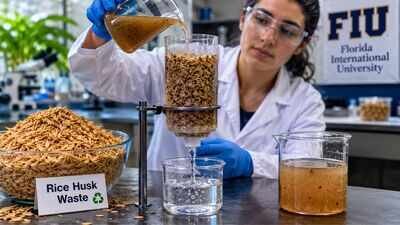
Florida scientists are turning rice husk waste into reusable water filters that can remove pollutants from contaminated water |

Rice leaves behind more than a meal. After the grain has been processed, the tough outer husk is usually treated as an unwanted agricultural residue, with enormous quantities accumulating every year. Much of it has little obvious use and can become an environmental burden when it is burned or dumped. At Florida International University, chemistry…

Read More

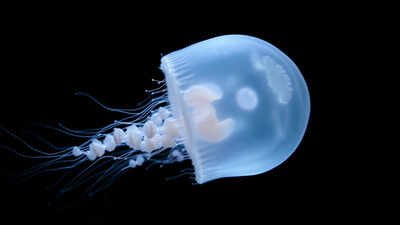
In 1991, NASA sent jellyfish into space, but many struggled to swim properly after returning to Earth |

Representative Image of jellyfish floating gracefully in a microgravity environment (AI-generated image) In 1991, NASA sent jellyfish into orbit as part of an experiment to understand how microgravity affects an organism’s sense of balance. The mission carried Aurelia jellyfish polyps aboard the space shuttle, where scientists induced them to develop into their next life stage…

Read More

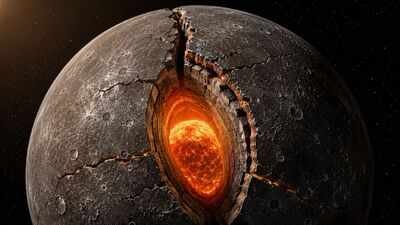
Mercury is still shrinking after billions of years: How its giant cooling core is cracking the planet’s thin crust |

Mercury is the smallest planet in the Solar System, only slightly larger than Earth’s Moon, but what lies beneath its battered surface is anything but small. Its metallic core stretches out to nearly 85 per cent of the planet’s total radius, leaving behind a rocky shell so thin it barely qualifies as a shell at…

Read More

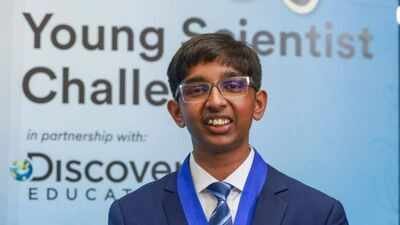
Meet Sirish Subash: The 14-year-old who invented an AI-powered pesticide detector for fruits and vegetables and won $25,000 |

A 14-year-old Georgia student has turned a common kitchen concern into an award-winning science project. Sirish Subash, a ninth grader from Snellville, built PestiSCAND, a handheld device designed to detect pesticide residues on fruits and vegetables. As reported by USA Today, his invention earned him the title of America’s Top Young Scientist in October 2024,…

Read More