
Cashew shells once treated as waste are entering the shipping industry, with their residue-based energy tested aboard a commercial vessel |
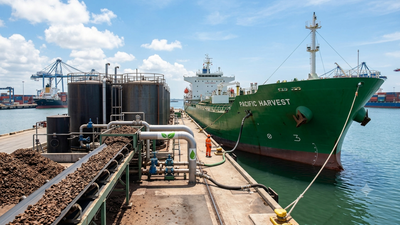
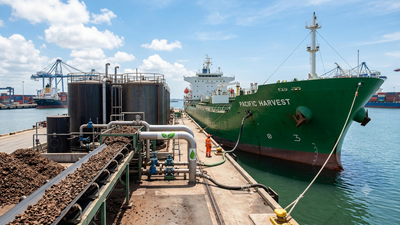
A pile of discarded cashew shells would normally have little to do with international shipping. In Maharashtra agricultural leftovers are being fed into reactors that can turn them into usable fuel, gases and biochar. The technology comes from an unusual India-Denmark partnership built around the Viking biomass gasifier developed at the Technical University of Denmark. MASH Makes is adapting that approach for smaller commercial facilities, using crop residues as a source of carbon and energy rather than simply leaving them as waste.The company has also explored a route from these materials to marine fuel, including a vessel trial in which its biofuel was blended with conventional fuel for auxiliary engines. Alongside the fuel, the process produces biochar that can be returned to agricultural soils, creating a production chain that links farms, fuel plants and shipping.
How Indian cashew shells are turned into fuel
Organic material is heated to high temperatures without oxygen, causing its complex molecules to break apart. This is pyrolysis, and depending on the equipment and conditions, the process can produce gases, liquids and biochar.Pyrolysis does not simply turn every piece of agricultural waste into a ready-made replacement for conventional fuel. Some of the resulting material can be difficult to handle, particularly the heavy, sticky compounds known as tar. Gasification takes the process further by using higher temperatures to convert much more of the feedstock into gaseous products alongside carbon-rich material.The distinction matters to MASH Makes because its longer-term plans involve both technologies. The company operates a facility in Maharashtra using four pyrolysis reactors based on technology associated with the Viking biomass gasifier developed at the Technical University of Denmark.Agricultural residues are collected through a nearby biomass hub before being processed. The resulting products have several destinations rather than being treated as a single fuel stream.
The Danish technology behind Indian cashew shell fuel
The Viking gasifier has become an important reference point for MASH Makes because of its efficiency. The system was designed to extract a large amount of usable energy from biomass while consuming comparatively little of that energy to operate the process itself.MASH Makes was founded as an Indian-Danish company with the aim of taking that underlying technology beyond the laboratory and into smaller commercial facilities. Its name comes from the initials of its founders, while the word “Makes” reflects the company’s broader interest in products made from biological residues.The company is not attempting to build one enormous processing complex. Instead, its model is based on deploying a collection of smaller units. That approach allows biomass to be processed closer to where agricultural residues are available, reducing the need to concentrate all the feedstock in a single location.
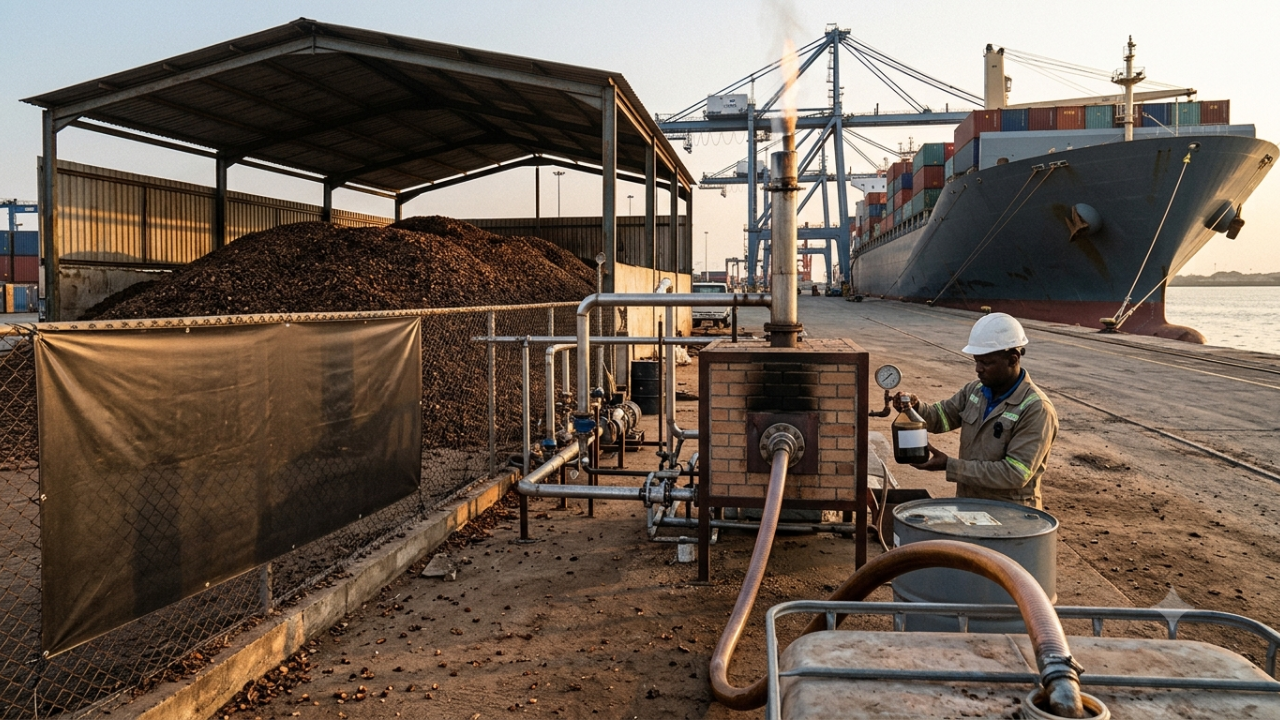
The biochar left behind after Indian cashew shells are processed
There is another product coming out of the process that is less obvious than fuel. Biochar, the stable carbon-rich residue left after organic material has been thermally processed, can be applied to agricultural soils.Its porous structure can help soil retain water and provides surfaces where microorganisms can live. It can also influence how nutrients behave in the soil. For farmers operating in areas where water availability is a concern, those properties can make the material useful beyond the fuel plant itself.This creates an unusual feedback loop. Agricultural residues become feedstock for the reactors, while some of the resulting biochar can be returned to farmland. In that sense, the material does not simply disappear into an industrial process; part of it makes its way back into the agricultural system.For MASH Makes, biochar sales currently represent only a small share of revenue. The company’s wider business also includes fuel and carbon credits.
From Indian cashew shells to fuel for ships
The liquid fuels produced at the Indian facility can be transported in tanks to local ports, where they enter wider fuel markets. That connection to shipping has already moved beyond the theoretical stage.MASH Makes has worked on converting tar, normally one of the troublesome products of pyrolysis, into a marine fuel. The company has reported a vessel trial in which its biofuel was blended with conventional marine fuel and used in auxiliary engines aboard a ship travelling between Brazil and Singapore.The significance of the trial lies less in the particular voyage than in what it demonstrates about the range of materials that can be considered for marine fuel production. Agricultural residues are not uniform, and neither are the compounds produced when they are heated. Turning difficult by-products into usable fuel requires further processing and careful control of the resulting fuel quality.Cashew shells are one example of the kind of residue that can enter this system. What began as a by-product of food production can become part of a chain leading to industrial fuel.
How smaller plants could bring Indian cashew shell fuel closer to farms
The company is also pursuing what it describes as a “numbering up” strategy. Rather than continually enlarging one processing plant, the idea is to establish multiple smaller production sites.That model can be useful for biomass because agricultural residues are scattered across large areas and can be expensive to move long distances. A network of facilities can potentially sit closer to collection points, allowing each plant to work with material available in its surrounding region.MASH Makes has financed its first two sites with backing that includes the Nordic Environment Finance Corporation and other investors. It is now working on financing arrangements for additional facilities as it develops the business.Its next-generation gasification equipment is intended to be more flexible about the types of organic material it can accept. The company’s first gasifier is housed in a 20-foot container and has been used as a pilot system. A larger 40-foot version is being developed for commercial deployment.