California had 2.34 million acres covered by a toxic yellow weed until tiny Australian beetles fought back and reduced it by 99% within a decade |
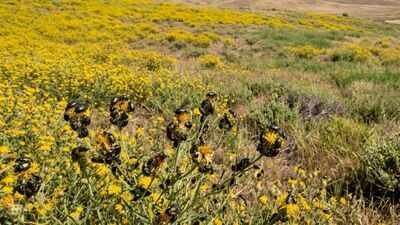
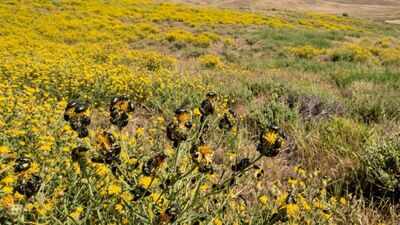
For years, St. John’s wort was treated as a useful medicinal plant in parts of Europe. In northern California, its reputation became very different. The yellow-flowered weed spread across pasture and open land, reducing the value of grazing areas and creating another problem for livestock because animals that consumed enough of it could become dangerously sensitive to sunlight. By the 1940s, the infestation had reached millions of acres, while repeated herbicide treatments were failing to provide lasting control. Researchers then tried an unusual alternative. According to Cornell University, in 1946, they released leaf-eating beetles brought from Australia, including Chrysolina quadrigemina, a natural enemy of St. John’s wort.The insects gradually multiplied and spread through infested areas, feeding on the weed’s foliage. Within about a decade, the plant had been reduced to a tiny fraction of its former abundance, turning the beetle release into one of the best-known early examples of biological weed control.
How a European medicinal plant became a threat to livestock in California
St. John’s wort, or Hypericum perforatum, has a long history that had little to do with its later reputation as an agricultural pest. Native to Europe, West Asia and parts of North Africa, the plant had been used for centuries in traditional medicine and folklore.Its arrival in North America produced a very different story. The plant was capable of spreading quickly, using both underground runners and large quantities of seed. It could establish itself in pastures, disturbed ground, along roads and in relatively open woodland.Northern California became one of the areas where it spread particularly widely. There it acquired the name Klamath weed, reflecting its prominence around the Klamath region.The problem was not simply that the plant occupied space that could otherwise support forage. St. John’s wort contains compounds that can make animals unusually sensitive to sunlight. Cattle and sheep eating enough of the plant could develop toxic reactions, making heavily infested grazing areas a concern for ranchers. The supplied source records an estimate of 2.34 million acres of northern California rangeland occupied by the weed before 1949.
Why herbicides failed to control California’s growing St. John’s wort problem
The conventional response was to try to destroy the plant directly. For years, herbicides were used against St. John’s wort, but they did not provide the sort of control that was needed. The weed’s ability to spread and regenerate made it difficult to keep infestations down over large areas of rangeland.By the 1940s, the scale of the problem had become substantial. Historical accounts describe St. John’s wort as a major threat to California pasture, with large areas of grazing country affected. A 1957 Scientific American account described how the infestation had expanded across hundreds of thousands of acres and damaged the value of heavily affected ranch land.The search for a solution therefore moved in a different direction. Rather than trying to make the environment hostile to the plant, researchers looked for something that naturally attacked it.
The answer came from leaf-eating beetles
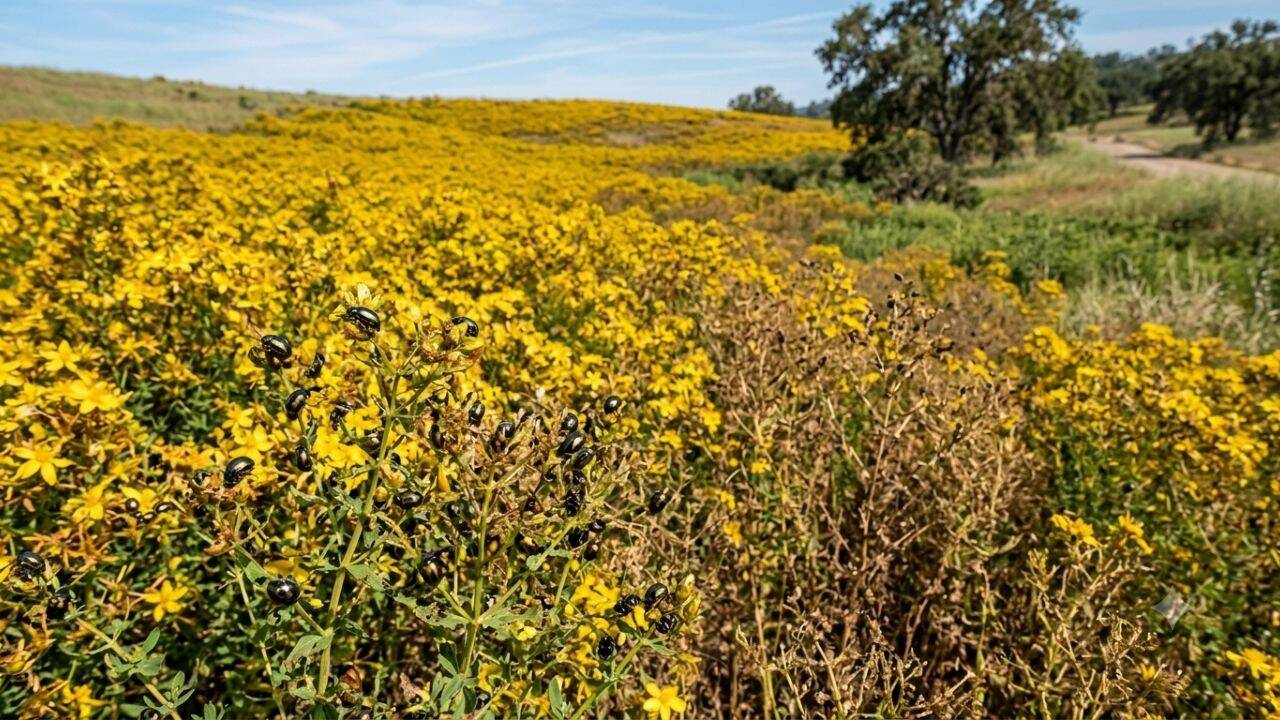
Scientists already knew that certain insects fed heavily on St. John’s wort in Australia. That observation offered a possible way to bring the weed under control without relying entirely on chemical treatments.According to the University of California, In 1946, two leaf-beetle species were introduced in northern California: Chrysolina quadrigemina and, to a lesser extent, Chrysolina hyperici. The source describes the insects as having been brought from Australia because of their strong appetite for Hypericum.Once established, the insects multiplied and spread through areas occupied by the weed. The greater St. John’s wort beetle, Chrysolina quadrigemina, proved particularly effective. Later reviews of the programme describe it as the dominant and more successful of the two leaf-feeding beetles used in the original effort.The beetles attacked the plant’s foliage rather than treating the symptoms of the infestation from outside. Heavy feeding could strip plants of leaves, leaving them with less capacity to grow and reproduce.A chemical treatment had to be applied again when the weed returned. An established insect population could reproduce and disperse through the infested landscape, creating a continuing source of pressure on the plant. Northern California’s stands of St. John’s wort had been reduced by 1957 to only 1% of their original number. That meant that a weed once spread across millions of acres of rangeland had been pushed down to a fraction of its earlier abundance in roughly a decade.
How biological control kept California’s weed at low levels
Biological control did not mean that St. John’s wort vanished completely. The plant and its beetle enemies remained in the landscape at lower levels. That distinction is important because biological control programmes generally aim to push a pest below the point at which it causes serious economic or ecological damage, rather than necessarily eliminating every individual.The historical evidence from California points to that kind of outcome. The weed was reduced dramatically while the biological-control agents remained part of the system. A long-term review described both the target plant and the beetle as continuing to exist at low numbers after the major decline.In practical terms, however, the difference was enormous. A plant that had once occupied huge areas of valuable grazing country was no longer the overwhelming presence it had been.
The beetle release became a landmark in biological control
The California programme is now remembered as an early demonstration of how carefully selected insects could reshape the abundance of an invasive weed.Later research has shown that Chrysolina quadrigemina was especially important in the reduction of St. John’s wort, while other biological-control agents were introduced in subsequent years.The outcome also illustrates why biological control can take patience. There was no overnight collapse after the first insects were released. Populations of the beetles had to establish, increase and spread before their feeding pressure became large enough to alter the plant population across broad areas. By the time the results were being recorded in the 1950s, however, the direction of change was difficult to miss.A weed that had once covered vast stretches of northern California rangeland had been reduced to roughly one-hundredth of its former abundance.