A 324-million-year-old fossil reveals an early insect with paddle-like limbs that lived between water and land before insects conquered Earth |
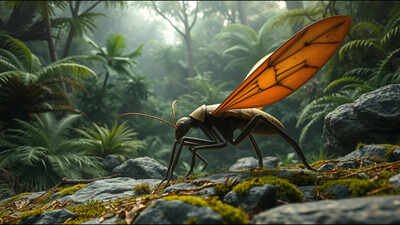
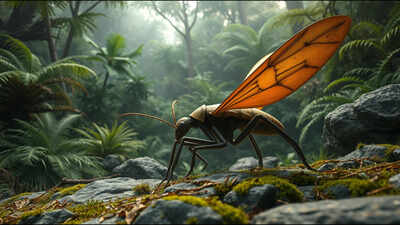
Today, insects occupy nearly every terrestrial environment on Earth and account for more described species than any other animal group, yet the earliest stages of their evolutionary history remain poorly documented. A newly described species from western Texas, named Chosha praecursor, now offers a rare glimpse into that missing chapter. The animal lived roughly 324 million years ago during the Late Mississippian and combined recognisably insect-like anatomy with a body plan unlike that of any living insect. It had three pairs of thoracic walking legs, but its abdomen retained segmented appendages across all nine abdominal segments, with the posterior ones modified into broad, paddle-like structures. The anatomy, combined with evidence that the animal lived in a near-shore, shallow-water environment, suggests a semi-aquatic lifestyle. Rather than showing an insect that had already completed the transition to life on land, the fossil provides evidence that some early insects retained and modified ancestral aquatic structures while adapting to humid environments at the boundary between water and land.
Why the fossil record has an 80-million-year gap in early insect history
According to the study titled Amphibious stem-insect sheds light on colonization of land, led by Chenyang Cai of the Nanjing Institute of Geology and Palaeontology and Erik Tihelka of the University of Cambridge and published in Nature, the early evolutionary history of insects falls partly within what palaeontologists call the “hexapod gap.” Molecular-clock estimates place the divergence and early diversification of hexapods considerably earlier than the oldest globally undisputed hexapod body fossils, which come from the Early Devonian Rhynie Chert in Scotland at about 405 million years ago. Unambiguous insect fossils also do not become abundant until much later in the Carboniferous. The result is a roughly 80-million-year interval in which the fossil evidence for early hexapod evolution is extremely sparse. Chosha praecursor, dating to about 324 million years ago, does not fill that entire chronological gap, but it provides important evidence about what early-diverging insects looked like and how they may have lived. The study also revises the identities and relationships of several other enigmatic Palaeozoic hexapod fossils, revealing that early wingless insects had a much greater diversity of body forms than their modern descendants.
How researchers identified Chosha praecursor after decades of misclassification
The fossils were recovered from calcareous claystone concretions in the Tesnus Formation of the Marathon Uplift in western Texas. The material had previously been interpreted as crustacean larvae, but researchers re-examined it using cross-polarised light imaging, which revealed anatomical details that were difficult to distinguish from the dark surrounding rock. The specimens represent adult females with a body length of 32.09 millimetres, extending to 49.66 millimetres when the terminal filament and two cerci are included. Their anatomy combines features diagnostic of insects with more primitive characteristics. The thorax bears three pairs of walking legs, while the animal also possesses an ovipositor and a terminal caudal filament, both important insect characteristics. The abdomen, however, is strikingly different from that of modern insects: segments one through nine each carry segmented appendages, giving the animal 18 additional abdominal limbs alongside its six thoracic walking legs. The posterior abdominal appendages are modified into paddle-like structures. Phylogenetic analysis places Chosha within the hexapod lineage and strongly favours its position as an early-diverging stem-group insect rather than a crustacean.
Why abdominal paddles point to a life lived between water and land
The most revealing structures on Chosha are the abdominal appendages. Modern crown-group insects have lost comparable abdominal limbs and retain their three pairs of walking legs on the thorax. Chosha, by contrast, retained appendages across all nine abdominal segments, with the posterior ones modified into flattened, paddle-like structures. The researchers describe these unusual structures as having gill-like characteristics and interpret them, together with the geological setting, as evidence for a semi-aquatic lifestyle. The fossils were preserved in sediments representing near-shore, shallow-water deltaic and coastal environments, suggesting that the animal occupied humid habitats along the boundary between aquatic and terrestrial ecosystems. Its anatomy indicates that it was not simply a fully aquatic arthropod that happened to resemble an insect: it already possessed the three pairs of thoracic walking legs, an ovipositor and other features associated with insects. The researchers therefore interpret Chosha as evidence that at least some early stem-insects lived in amphibious environments while retaining ancestral structures associated with aquatic life. They also propose that these early insects may have fed on humus, plant detritus and fungal spores, potentially making them both consumers and decomposers within developing aquatic-terrestrial ecosystems.
What the loss of abdominal limbs reveals about how the modern insect body evolved
The significance of Chosha lies in showing that the familiar six-legged insect body plan was not necessarily assembled all at once. The fossil demonstrates that an early-diverging insect could already possess the characteristic three pairs of thoracic walking legs and specialised structures such as an ovipositor while retaining a series of abdominal appendages that have disappeared from living insects. The researchers argue that insect terrestrialization was a gradual process involving the retention, remodelling and eventual reduction of ancestral aquatic structures. In that interpretation, the transition to life on land was not a single evolutionary leap but a prolonged period during which early insects occupied environments along the water-land boundary. The researchers’ re-examination of other Palaeozoic stem-group fossils, including Leverhulmia from the Devonian of Scotland and enigmatic Carboniferous hexapods from the Mazon Creek Lagerstätte in Illinois, further suggests that early insects possessed a diversity of body organisations that has largely disappeared. Chosha therefore provides a rare snapshot of an evolutionary stage in which insect-like anatomy and aquatic adaptations existed together, helping researchers reconstruct how the modern insect body plan emerged from more anatomically complex ancestors.