
8-year-old exploring ramon crater discovers rare 1,700-year-old statue fragment |
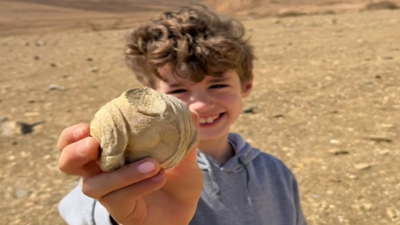
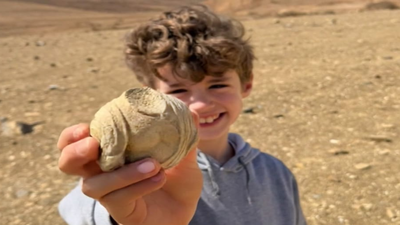
An excursion with the family through the rugged beauty of Ramon Crater is usually about amazing views and the quiet of the desert. For 8-year-old Dor Wolynitz, the experience turned into an intimate experience with the empire. As he walked through the rough landscape of the southern part of Israel in the course of a weekend excursion with his parents and some paratrooper reserveists, Dor spotted a small and striped stone which appeared like something else.This “stone” turned out to actually be a 1,700-year-old piece from a Roman time statuette. The size is 6 by 6 centimetres, and it depicts a small human being draped in hefty, delicately designed fabrics. This isn’t an opportunity for an enthralled child. It’s an insight into the melting pot of cultures of the antiquated Negev and the bustling trading which once ruled the area.A child’s eye for historyChildren are often gifted at noticing the little things that adults miss. Dor was looking for something different to present to his students when he came across the artefact. At first, even experts fell for it. Akiva Goldenhersh, who is a member of the family and director of the Israeli Antiquities Authority’s Theft Prevention Unit, first thought it could be a fossil.On closer examination, those “stripes” Dor had noticed were revealed to be the delicate pleats that were made of a dress. The findings highlight a theme that is often referred to in the field of heritage studies, which is the crucial role played by “citizen science” and public involvement in archaeology. If ordinary citizens engage in their environment with a sense of responsibility as they do, they can be the first line of preservation. Because of his quick thinking and sincerity, Dor received a certificate of good citizenry from the IAA and proved that you’re never too old to safeguard the heritage of a country.The art of the ancient frontierThe thing that makes this piece of art interesting to historians is the fact that it has something to say about the local production. The majority of the high-quality statues dating from the Roman period that were found in Israel were made from imported marble. A geological study done by Dr Nimrod Wieler found that the statue was made of the mineral light phosphorite. It is native to the Negev.The statuette was likely carved in the area rather than imported to Rome or Greece. The artistry is still impressive in spite of the material used in the region. The subject is dressed in a “himation,” a type of heavy mantle or cloak that is typically worn across the shoulders. It is interesting to note that the model appears to be wearing no “chiton,” or undergarment, underneath the garment.The blending of the top-end Hellenistic style and local stone is an excellent instance of cultural hybridisation. Studies into this phenomenon are vast, including research within the Journal of Roman Archaeology, which frequently examines how artisans from the provinces modified classical designs to suit local tastes and resources. The small-scale productions of local artisans illustrate that even at the margins of the Empire, the people were very interested in the cultural and spiritual styles that dominated in the Mediterranean world.
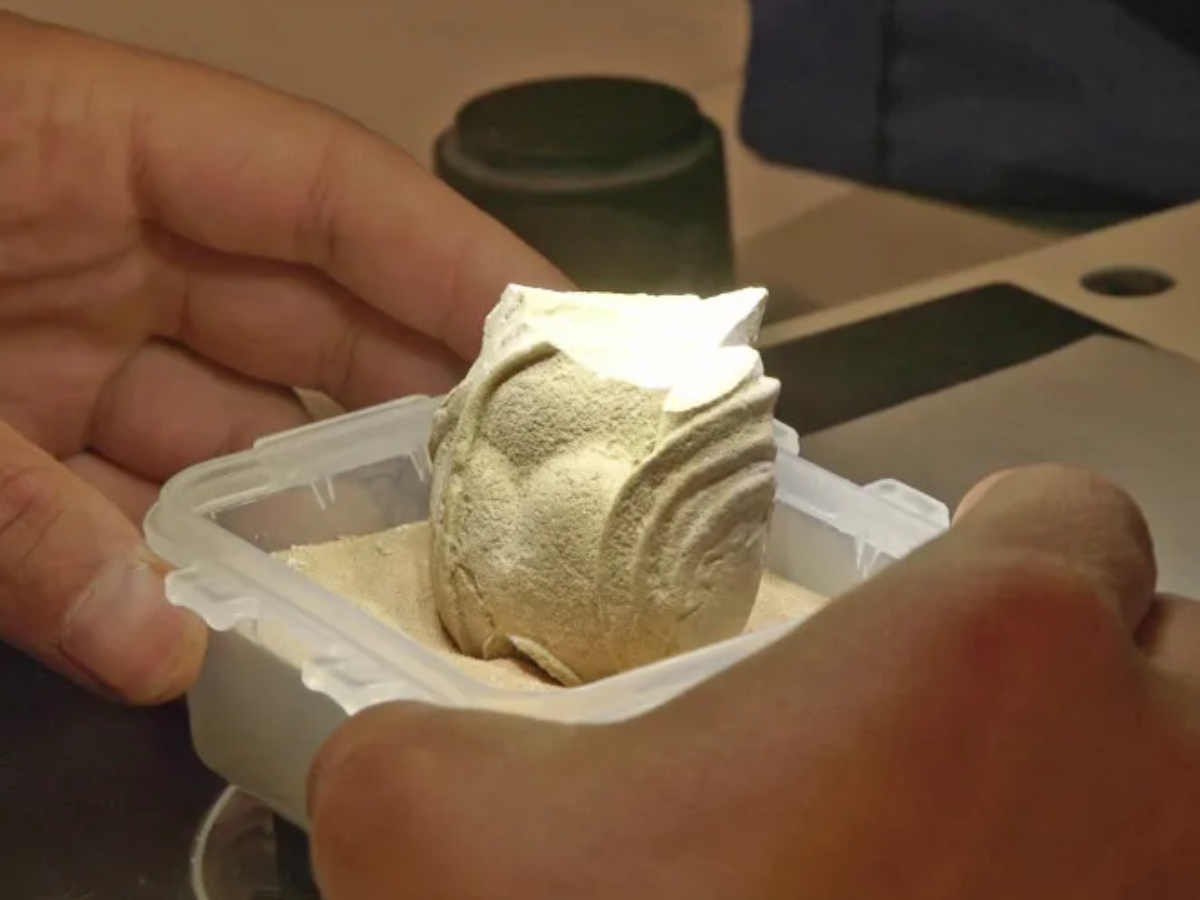
Statuette fragment found in Ramon Crater area, May 11, 2026. Image Credit: EMIL ALADJEM/ISRAEL ANTIQUITIES AUTHORITY
Who Was the Mystery Figure?The fragment’s size isn’t huge and doesn’t have any identifying symbols such as the lightning bolt or Sceptre, archaeologists can guess who it is. Two of the most likely contenders are the heavyweights of the pantheon of ancient times: Jupiter or Zeus-Dushara.This is particularly fascinating. Zeus-Dushara symbolises a spiritual “merger” between the Greek god of gods, the king of gods, as well as the Nabataean god Dushara. The kind of merging that was religious was common in the regions that Nabataean trade routes crossed, along with Roman influence. The Nabataeans are famous for the construction of their city. Petra was a master of the desert. And after their integration with the Roman Empire, the gods of their religion began to look more like the gods from the West.The legacy of the spice routeThe place of the discovery is as important as the actual object. It is believed that the Ramon Crater sits along the long-standing Spice Route, a massive system of causeways connecting the Arabian Peninsula to the Mediterranean ports. It was an “information superhighway” of antiquity, transporting myrrh, frankincense, and exotic items throughout the desert.The discovery of a premium-quality statuette from this region indicates that those who travelled or lived along these roads were not simply agribusiness traders. They were people who carried their art as well as their religion and culture on the journey. The findings are in line with those that were published by The Journal of Hellenic Studies, wherein they frequently study the expansion of Greek and Roman icons of religion along trade routes in the Near East. This research demonstrates that trade routes not only performed transport goods, but also shifted concepts and identities.Preserving our shared heritageThe Minister of Heritage, Amichai Eliyahu, stated that this discovery will remind us of how much historical information can be found right under our feet. In the case of the IAA, the process of Dor transferring the artefact is the main point of the tale. When objects are removed from their contexts and not documented, a part of the puzzle disappears forever. In bringing it back, Dor ensured that researchers could study exactly where the material is. This adds another piece of evidence to our knowledge of the Roman Negev.The fragment of stone is taken care of in the National Treasures Department. It is a symbol that the desert isn’t only a barren space of stone and sand, but is actually a living document of the human experience. From a young boy in search of something to display and show off to an old artist creating local stonework, the story behind this sculpture is a bridge over 17 centuries. It reminds us that we’re always moving on the layers of people before us.