





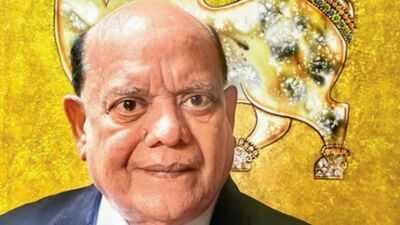
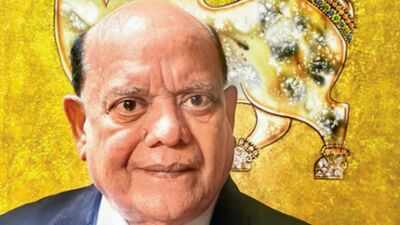
During his time as Prime Minister, Atal Bihari Vajpayee was invited for a kavi sammelan at Talkatora stadium by Surender Sharma, the roof-raising poet of humour.The BJP leader, who also wrote poetry, agreed to attend, on the condition that he won’t be asked to recite his verse. But the packed house repeatedly urged him to. “Kavita, kavita (poetry, poetry),” they insisted.Sharma then briefed the audience about his earlier promise to Vajpayee. But he also added, tongue firmly in cheek, “Kavi chahe Prime Minister bhi ho jaye, jab tak payment nahi mil jaata, kavita nahi padh sakta (A poet might become the Prime Minister, but he won’t recite a poem until the payment comes through).”It goes without saying that Vajpayee, who had also penned comic verse in jail during Emergency, returned to the mic and recited his verse — without any payment.The incident underlines Sharma’s ready wit, the hallmark of a career spanning six decades. His light-hearted verse and homespun wisdom, flavoured in Haryanvi and delivered deadpan in a signature rasping voice, has made him a major crowd-puller in ticketed events, both home and abroad.“I have performed in about 40 countries, including Nigeria and Tanzania,” he says. “I am on my fourth passport.”The ‘hasya kavi’ has also headlined FM radio shows, endorsed ceiling fans and replied in dailies to funny questions with funnier answers — much like comic genius I S Johar and actor-politician Shatrughan Sinha once did for Filmfare.His clever lines have supplied an amusing arsenal to poll campaigns. Nargis, the 50s diva, would recite them, he remembers. His work has also been repurposed as books and cassettes, the bestselling ‘Chaar Laina (Four Lines)’ one of them.The rhymester is scheduled to perform in Bangkok later this year, and in Singapore in Jan 2027. Even at 82, Sharma is laughing his way to the bank.It’s a Saturday afternoon. And the drilling machine’s drone outside his cosy Civil Lines residence is uncomfortably high. But having just relished a lunch of masala dosa and idlis, Sharma’s tenor rises above the hum as he recalls the past.He was born in Nangal Choudhary village, then part of princely Patiala in a family of vaidyas, ayurveda doctors.When four years old, his father shifted to Old Delhi’s Khari Baoli area. “Stepping out of home, you often opened an umbrella for fear of drain water falling on you,” he recalls.The poet still savours the area’s street food: how the jalebis of Kucha Brijnath were thicker than those of Dariba Kalan, and how the taste of Nagori puri-halwa and aloo-bedmi combos tease his tongue and linger on in his memory.School hardly enthused Sharma. As a teenager, he would assist his father taking orders for his ayurvedic medicine factory, aware that he would someday take over the enterprise.College, though, was fun. He would write applications in rhyme to the principal. “My friends were all loafers,” he confesses, “But we did one good thing: save newcomers from ragging.”After failing once in 1963, Sharma earned his BCom degree from Sri Ram College of Commerce.Poetry gatherings, both in Hindi and Urdu, were then a rage in Old Delhi. A ‘hasya-ras kavi sammelan,’ where actors like Prithviraj Kapoor and Agha would grace the occasion, was also held.Egged on by funster friends, Sharma would recite his “tukbandi” (rhymes) in one such gathering. It seemed he had a flair for humour in rhyme.“I would get Rs 100 for reciting poetry at the famous Lal Qila sessions. (Harivansh Rai) Bachchan ji would get Rs 200,” he remembers.In time, his reputation would grow, along with his fees. Sharma’s banter with his wife in verse is part of Hindi humour poetry lore.“Main hasya karta tha. Aaj log uphaas karte hain (I would indulge in humour, not ridicule like people today),” he insists, adding, “Women are my biggest fans.”But in time, his witticism would become more socially meaningful and politically aware. “My humour is educational. Vyang (satire) should make people chuckle, not hurt anyone,” he says.His poetry impacts people. After listening to ‘Ek kamre mein rehta ttha’, a poem which underlines that though our homes have grown bigger, generosity hasn’t, a teenager asked him whether he planned to visit Pune again.On being asked why, he said, “My father doesn’t respect my grandfather. I would like him to learn from your words,” the poet recalls.Sharma, who received the Padma Shri in 2013, also recalls a regrettable incident in Hong Kong, when he was part of a visiting group of poets.Some of them were paan masala users and would invariably dirty the washbasin and linen in their hotel room. When checking out, the manager told them that the hotel would not entertain any Indian in future.“I wasn’t among the culprits. But that incident is embedded in my brain,” he says, “If you do something in your own country, you get a bad name. When you do something wrong abroad, your country gets a bad name.”Apart from Vajpayee, Sharma has vivid memories of interactions with other PMs.The poet remembers accompanying former Rajasthan CM Jagannath Pahadia to Indira Gandhi’s residence at Willingdon Crescent and reciting poems. “After some time, (the influential swami) Dhirendra Brahmachari came and said, ‘Utho Indira’, and she left,” he says.Sharma would also recite his work to Rajiv Gandhi on Indira’s death anniversary. “A few years later, he asked me casually, ‘Why don’t you join politics?’ I told him, in half-jest, ‘Why don’t you join kavi sammelans?’”Sharma has also done a cameo in Manoj Kumar’s unwatchable ‘Santosh’. “I haven’t seen any film I have acted in. I don’t want to hate myself,” he smiles.A humourist who laughs at himself will seldom fall short of jokes.