Court: ‘Don’t just say ED, ED, ED’: Supreme Court questions West Bengal government in Mamata I-PAC raid case | India News
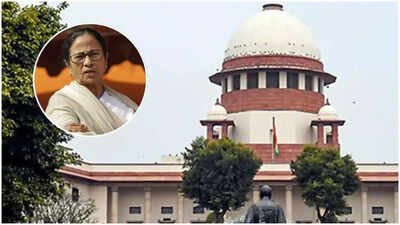

NEW DELHI: The Supreme Court on Tuesday questioned the West Bengal government over its objection to the maintainability of the Enforcement Directorate’s plea alleging obstruction by Chief Minister Mamata Banerjee during a January 8 raid at I-PAC, asking what remedy ED officers would have if their rights were allegedly violated.As per news agency PTI, a Bench of Justices Prashant Kumar Mishra and N V Anjaria said some ED officers had also moved the court in their individual capacity, raising the issue of whether they cease to be citizens merely because they serve in the agency.
Court asks state to focus on ED officers’ rights
During the hearing, senior advocate Kapil Sibal, appearing for Banerjee, argued that a petitioner invoking Article 32 must clearly show which fundamental right has been violated.He submitted that the ED officer who filed the writ petition had not specifically pleaded any violation of fundamental rights and said the ED itself was not even a “person” for the purpose of such a petition.At this stage, Justice Mishra told the state to look beyond the agency as an institution and focus on the officers who had also approached the court.“Please concentrate on the fundamental rights of the officers of the ED with whom the offence has been committed. Otherwise, you will miss the point. You can’t forget the second petition which is preferred by individual officers who are the victims of the offence. You will be in difficulty, I am telling you. Don’t just say ED, ED, ED,” Justice Mishra observed, as quoted by Bar and Bench.The court also asked whether ED officers cease to be citizens of India merely because they are officers of the agency.The Court further said “different political parties govern centre and states. If some chief minister of the other side does this in 2030 and 2031 and you come in power in central government and their chief minister does this, what will be your reaction?”
Kapil Sibal says obstruction of statutory duty is not a fundamental rights issue
Sibal argued that obstruction in the performance of a statutory duty cannot automatically be treated as a violation of a fundamental right.He said, “If someone obstructs a police officer, he can’t file a petition under Article 32. He also can’t file a 226 petition. There will be a prosecution launched for the obstruction of violating his right to discharge his functions.”As quoted by Bar and Bench, Sibal also told the court, “Any obstruction in performance of a statutory duty is not in violation of a fundamental right. If someone obstructs a police officer, he can’t file a 32 petition. There is a statutory remedy. Otherwise every police officer will file a 32. We can’t interpret a law in the context of a particular situation and then open a Pandora’s box inconsistent with the basic features of criminal law.”He further argued that an ED officer has only a statutory right to investigate, not a “fundamental right” to do so. “He (ED officer) only has a right under a statute to investigate. And violation of that right is not a violation of fundamental right,” Bar and Bench quoted him as saying.
Bench questions whether ED should seek remedy from CM-led state
The Bench also raised a sharp question over the practical consequence of the state’s argument.“If the CM barges into an ED investigation and commits an offence, your idea of remedy for the ED is to go to the state government which is headed by the CM and inform them about it and seek remedy?” Justice Mishra asked.Sibal responded that the court was presuming the Chief Minister had committed an offence. “Your lordships are assuming that the chief minister has committed an offence,” he said, according to PTI.Justice Mishra clarified that the Bench was not making any finding and was only referring to the allegations in the plea.“We are not assuming anything. That is the allegation. Do not mistake us. Every allegation is based on some facts, if there are no facts, there is no need to be investigated. That is what they are praying for, for CBI to investigate,” the judge said.Sibal also argued that if ED officers came across another offence while investigating under the Prevention of Money Laundering Act (PMLA), they should inform the concerned agency — in this case the state government — under Section 66 of PMLA.
Court rejects suggestion to defer hearing due to elections
The Supreme Court also firmly pushed back against a suggestion that the case be postponed because of the upcoming West Bengal Assembly elections.According to Bar and Bench, senior advocate Kalyan Banerjee, appearing for Banerjee, referred to an earlier instance where a judge had declined to hear a matter due to elections.The Bench, however, made it clear it would not entertain such a request.“We don’t want to be party to election, we don’t want to be party to any crime also. We know the timing of the court. We know the timing of the decision,” Justice Mishra said, as reported by Bar and Bench.Kalyan Banerjee also argued that the state’s consent is required for a CBI investigation, though constitutional courts have the power in appropriate cases.
Hearing remains inconclusive, next date on April 14
The hearing remained inconclusive and will continue on April 14.The matter centres on the ED’s plea alleging interference and obstruction by the West Bengal government, including Mamata Banerjee, during its January 8 search at the I-PAC office and the premises of its director Pratik Jain in connection with an alleged coal-pilferage scam.The agency has sought a CBI probe and also challenged the FIRs lodged in West Bengal against its officers.
Case stems from January 8 I-PAC raid in coal smuggling probe
Banerjee allegedly entered the I-PAC office and the residence of its co-founder while ED officers were conducting searches in connection with a money laundering investigation and allegedly removed documents and electronic devices from the premises.She reportedly claimed the material related to her political party. I-PAC has been associated with the Trinamool Congress since the 2019 Lok Sabha elections.The ED has said the searches were linked to its probe into a 2020 money laundering case against businessman Anup Majee, accused of involvement in coal smuggling.The agency alleged that a coal smuggling syndicate led by Majee illegally excavated coal from Eastern Coalfields Ltd (ECL) leasehold areas in West Bengal and sold it to various factories and plants in the state, with a large part allegedly sold to the Shakambhari Group of companies.
Earlier, SC had termed obstruction allegations ‘very serious’
On January 15, the top court had described the allegations against the Chief Minister as “very serious” and agreed to examine whether a state’s law-enforcing agencies can interfere with a central agency’s investigation into a serious offence.It stayed the FIRs filed against ED officials who carried out the raid and directed the West Bengal Police to preserve the CCTV footage of the operation.The court had also issued notices to Mamata Banerjee, the West Bengal government, former DGP Rajeev Kumar and senior police officials on the ED’s petitions seeking a CBI probe.Tthe Bench also questioned where the ED would go if it could not move the Supreme Court under Article 32 or a High Court under Article 226, observing that “there cannot be a vacuum.”
State says ED plea under Article 32 is not maintainable
The West Bengal government has consistently opposed the ED’s move under Article 32.The state argued the searches at I-PAC were not obstructed, and that the ED’s own panchnama showed this.It also contended that an Article 32 petition can be filed only by citizens alleging a violation of fundamental rights, and therefore the ED’s petition against a state government is not maintainable.The state warned allowing a central government department to file a writ petition against a state government could be dangerous to the federal structure.