Artemis 2 crew nears farthest distance ever flown by humans; Moon flyby to begin soon – latest updates

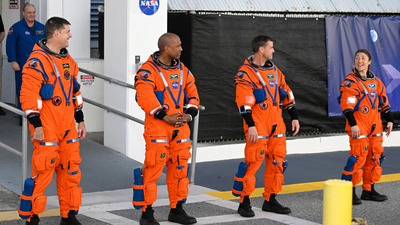
Nasa’s Artemis 2 astronauts are set to make history Monday, April 6, as they fly around the moon, becoming the first humans in more than 50 years to see it up close.The four-member crew- commander Reid Wiseman, pilot Victor Glover, and mission specialists Christina Koch and Jeremy Hansen- are scheduled to begin their seven-hour moon…

Read Full News

Orion Spacecraft: Where are the astronauts living inside the Orion spacecraft on their mission to the Moon |

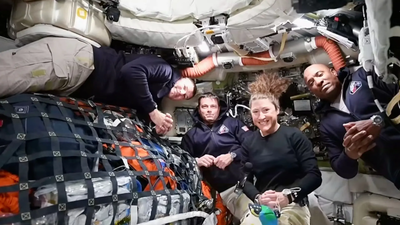
Since time immemorial, space exploration has been synonymous with great fascination and has attracted many humans. But being up there in space is nothing like glamour. With the Artemis program of NASA, astronauts flew to the Moon on board the Orion spacecraft that was specifically designed to perform as both a home and a workplace…

Read Full News

NASA’s Artemis II mission: Crew honours Jeremy Hansen with ‘astronaut gold pin’, an elite spaceflight award |

PC: Canadian Space Agency The Artemis II mission has achieved an historic milestone that heralds a new epoch, and a mark of tradition and accomplishment for Canada as well. A significant milestone along this great journey, as the Orion spacecraft transitions into its trans-lunar trajectory, Commander Reid Wiseman, with his fellow veteran crew members, honoured…

Read Full News

Nasa’s Artemis II crew reaches Moon, nears farthest distance ever flown by humans

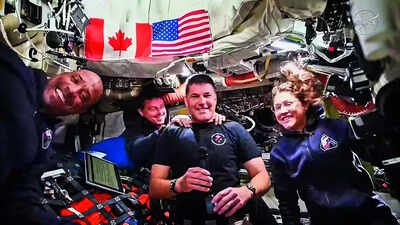
Artemis II mission specialist Jeremy Hansen, left, of the Canadian Space Agency, pilot Victor Glover, second from left, commander Reid Wiseman and mission specialist Christina Koch, right. (Image credits: AP) The four astronauts aboard Nasa’s Artemis II mission entered the moon’s gravitational sphere of influence early Monday morning, moving toward a key milestone in the…

Read Full News

Quote of the day by Max Planck: “Science cannot solve the ultimate mystery of nature. And that is because, in the last analysis, we ourselves are a part of the mystery that we are trying to solve.” |

Quote of the day by Max Planck (Image source: Wikipedia) Science has helped people understand the world in ways once impossible. Scientific discoveries have changed our lives in many ways, from understanding how planets move to discovering what atoms are made of. But even with all of these improvements, there are still a lot of…

Read Full News

Artemis 2 Updates: Artemis II: Why Artemis II astronauts lost contact with Earth for 40 minutes during its Moon mission |

For much of their time in space, astronauts are connected to the Earth via an invisible network of communications: voices, information, and continuous assurances from Mission Control. However, for NASA’s Artemis II mission, there is a defining point at which all such connections disappear. The astronauts inside the Orion capsule were silent for approximately 40…

Read Full News

Why Artemis II astronauts lost contact with Earth for 40 minutes during its Moon mission |

For much of their time in space, astronauts are connected to the Earth via an invisible network of communications: voices, information, and continuous assurances from Mission Control. However, for NASA’s Artemis II mission, there is a defining point at which all such connections disappear. The astronauts inside the Orion capsule were silent for approximately 40…

Read Full News

Artemis II: Radio silence, solar eclipse, ‘Earthrise’ redux: What Artemis II astronauts will see during Moon flyby |

Artemis II astronauts are set to break the record for travelling the farthest distance from Earth to the Moon on a crewed mission, surpassing what Apollo 13 achieved by more than 4,100 miles (6,600 kilometers).During their journey, the four-member crew will spend about six hours flying around the Moon on Monday, capturing clear views of…

Read Full News

Scientists discovered at least 11 new species in Cambodia’s rocky ecosystems |

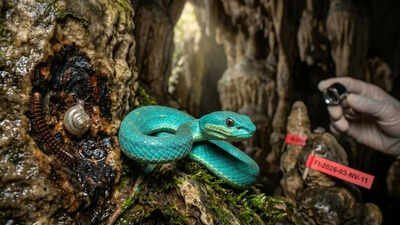
After years of extensive biological research, scientists identified at least 11 species new to science occupying the ruggedly divided limestone formations of the Battambang and Stung Treng regions in Cambodia. The researchers describe these remote, isolated outcroppings of limestone as ‘evolutionary laboratories,’ where organisms have evolved for millions of years independently of each other. Among…

Read Full News