
In 2025, scientists examined three king cobra encounters in Thailand, revealing a little-known side of the venomous snakes that had long been missing from scientific research |
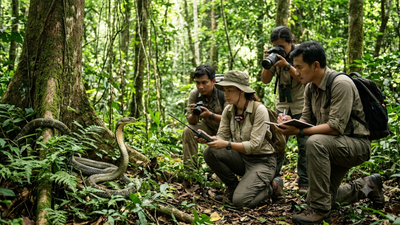
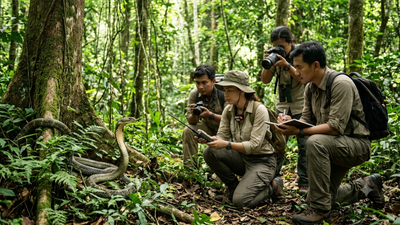
Two male king cobras meeting during the breeding season may engage in a prolonged contest, using their bodies to wrestle for control rather than relying on the venomous strikes associated with these snakes. The behaviour has long been recognised in accounts of king cobras, yet detailed scientific descriptions have been scarce. In Thailand, observations made during the 2019 breeding season provided researchers with an opportunity to examine these encounters more closely. A paper published in 2025 documented three instances of ritual combat involving the northern king cobra, adding direct and indirect evidence to a part of the species’ natural history that had largely rested on anecdotal reports.
King cobra combat study documents three encounters in Thailand during 2019
According to the Ecology and Evolution study, titled ‘Ritualistic male–male combat of the northern king cobra (Ophiophagus hannah) in Thailand‘, published by David Roman Bontrager and colleagues. The team recorded three instances of combat during the 2019 breeding season in Thailand, drawing on both direct observations and indirect evidence.The distinction matters because the behaviour is familiar to people who study snakes, but its details have not been well documented in published research on king cobras. Accounts and footage shared informally have suggested that males engage in physical contests, yet they do not always provide enough information to describe what happens, how the encounter develops or how it ends.The researchers set out to record these events in a scientific account. Their work adds observations of northern king cobras to the literature on ritualised combat, a behaviour also known in several other snake species.
What happens when male snakes compete
Ritual combat in snakes generally involves two males attempting to overpower one another through physical contact. The contest can include raising the front portion of the body, pressing against an opponent and attempting to force the other snake down. Unlike a straightforward attack on prey, the interaction is primarily a contest between rivals.Such encounters are associated with competition for access to mates. A male that succeeds in forcing its opponent into a subordinate position may gain an advantage during the breeding season. The outcome does not necessarily depend on which snake is larger, since strength, positioning and the ability to maintain control can all influence the contest.King cobras are among the world’s largest venomous snakes, and their size makes these encounters particularly striking. Their reputation for venomous bites can also obscure the difference between a defensive or predatory interaction and a contest between males. Ritual combat is a separate form of behaviour, in which physical dominance rather than the delivery of venom is central.
Why the king cobra’s changing classification matters
The research also comes after a major change in how scientists classify king cobras. The animals once treated as a single widespread species have been divided into four distinct species within the king cobra complex. Behaviour reported in one population cannot automatically be assumed to apply in the same way to every member of the group. Differences in habitat, breeding patterns and other aspects of natural history may emerge as scientists gather more evidence from the newly recognised species.The northern king cobra, Ophiophagus hannah, is the focus of the Thai observations described in the paper. By identifying the animals within the revised classification, the authors help establish which species the recorded behaviour applies to, rather than treating the findings as evidence for all king cobras without qualification.
How three king cobra encounters help fill a gap in scientific research
The authors point to a gap between the accepted understanding of king cobra behaviour and the published evidence supporting it. Male–male combat has commonly been regarded as part of the species’ natural history, but detailed descriptions of the interactions have been missing from the primary literature.Observations shared by field workers and members of the public have helped establish that such contests occur. The problem is that informal accounts can vary in the information they provide, making it difficult to compare events or draw firm conclusions about how the behaviour works.By bringing three encounters into a scientific paper, the researchers provide a starting point for further comparisons. The observations can be considered alongside reports of ritual combat in other snakes, helping scientists examine which features may be shared across species and which might be specific to king cobras.
What the observations add to king cobra research
King cobras are difficult animals to study in the wild. They occupy a range of habitats across parts of Asia, and their size, behaviour and venom make close observation challenging. As a result, some aspects of their lives are better known than others. Their feeding habits and defensive displays have received attention, while specific interactions between breeding adults have been less thoroughly recorded.The Thailand paper adds detail to that less-documented area. Its three observations do not provide a complete account of the species’ mating behaviour, but they give researchers material that can be examined, compared and tested against future field records.