University of Michigan engineers created an underwater vehicle concept with adjustable golf-ball dimples; the surface reduced drag by 50% in wind tunnel tests |
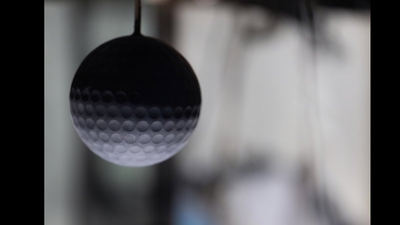
Engineers at the University of Michigan have developed a spherical prototype with adjustable golf-ball-like dimples that can reduce drag and control steering by changing its surface texture. The device uses a vacuum pump to switch between smooth and dimpled surfaces, allowing researchers to adjust its response to different airflow conditions. According to the University of Michigan, wind tunnel tests showed that the prototype reduced drag by 50% compared with a smooth sphere and generated lift forces reaching 80% of the drag force when one side was dimpled and the other remained smooth. The technology is a potential approach to improving manoeuvrability and efficiency in future underwater and aerial vehicles.
How engineers built an underwater vehicle with adjustable golf-ball dimples
The researchers constructed the prototype by stretching a thin layer of latex over a hollow sphere containing holes, giving the underlying structure an appearance similar to a pickleball. A vacuum pump depressurises the sphere’s interior, pulling the latex inwards through the holes and forming dimples across its surface. When the pump is switched off, the surface returns to a smooth state.The setup allows researchers to adjust the depth of the dimples by changing the strength of the vacuum. This provides a way to modify the sphere’s surface in response to different flow conditions. The team suspended the prototype from a thin rod inside a three-metre-long wind tunnel and exposed it to different wind velocities. A load cell measured the drag force acting on the sphere, while an aerosol, a high-speed laser and a camera helped researchers observe the movement of particles around its surface.
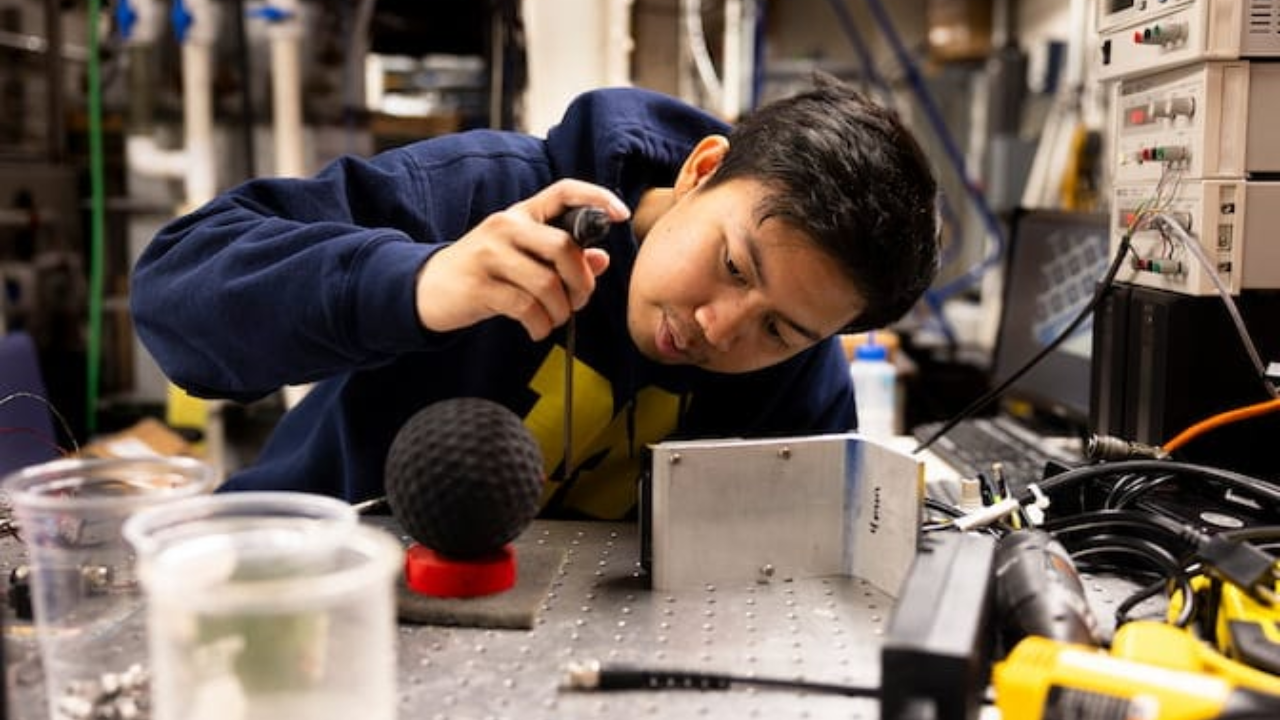
PC: University of Michigan
How golf-ball dimples reduced drag by 50% in wind tunnel tests
The wind tunnel experiments showed that the most effective dimple depth depended on the speed of the incoming airflow. Shallower dimples reduced drag more effectively at higher wind speeds, while deeper dimples performed better at lower speeds. By adjusting the depth, the prototype reduced drag by 50% compared with a smooth sphere across the tested conditions.Rodrigo Vilumbrales-Garcia, a postdoctoral research fellow in naval architecture and marine engineering at the University of Michigan and a contributing author to the studies, explained the potential significance of this adaptive surface. “The adaptive skin setup can notice changes in the speed of the incoming air and adjust dimples accordingly to maintain drag reductions,” he said. He added that applying the concept to underwater vehicles could reduce drag and fuel consumption. The reported findings were obtained through wind tunnel testing, rather than through demonstrations of a fully operational underwater vehicle.
How adjustable dimples generated lift for underwater vehicle steering
Beyond reducing drag, the researchers investigated whether changing the surface texture on only one side of the sphere could generate lift and provide directional control. They designed the sphere’s internal structure with holes on one side, allowing the activated surface to develop a dimpled side while the opposite side remained smooth. This asymmetric arrangement altered the flow around the sphere and caused the wake to deflect towards the smooth side.The resulting pressure and flow differences generated a force towards the dimpled side, allowing the researchers to control the direction of the lift by selecting which side of the sphere was roughened. With an optimal dimple depth, the half-smooth, half-dimpled sphere generated lift forces reaching 80% of the drag force. The researchers reported that this lift generation was comparable in strength to the Magnus effect, which typically involves rotation, whereas the prototype produced lift by modifying its surface texture instead.
How adaptive skins could help underwater robots steer without rotating
The research team identified compact spherical robotic submarines as one potential application for the technology. Such vehicles could be designed for exploration, inspection, surveillance, mapping and the collection of data about water conditions, including in areas that are difficult for conventional vehicles to reach. Sareen explained that a programmable outer skin could reduce the need for protruding manoeuvring components, potentially allowing vehicles to change direction by modifying their surface rather than depending entirely on traditional control mechanisms.Putu Brahmanda Sudarsana, a mechanical engineering graduate student at the University of Michigan and a contributing author to the studies, highlighted the significance of generating lift without continuous rotation. He said the approach could benefit compact spherical robotic submarines that prioritise manoeuvrability over speed. According to Sudarsana, conventional submarines of this type would typically require multiple propulsion systems, while the proposed mechanism could help reduce that requirement. The university also identified further work involving materials science and soft robotics as a potential direction for developing the technology. The current research establishes the prototype’s aerodynamic behaviour in controlled wind tunnel experiments, while its practical performance in underwater vehicles remains a subject for further development.