Scientists engineered bacteria to make stronger silk fibres using mussel protein fragments, boosting tensile strength by up to 345% |
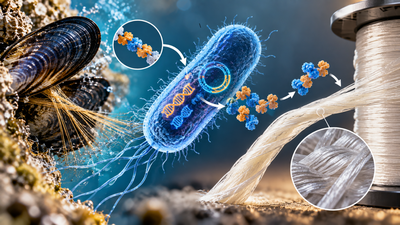
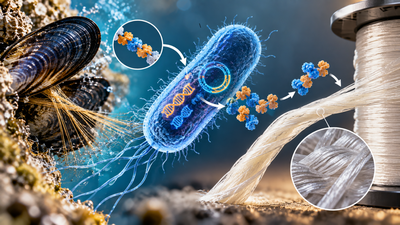
Scientists have engineered bacteria to produce a silk-based protein using a surprising ingredient: a protein fragment from mussels. The approach combines an artificially designed silk protein with mussel foot protein 5, or Mfp5, which the researchers found could improve the strength and toughness of the resulting fibres. According to the study published in Nature Communications, titled ‘Bi-terminal fusion of intrinsically-disordered mussel foot protein fragments boosts mechanical strength for protein fibres’, attaching Mfp5 fragments to both ends of the protein encouraged interactions between protein molecules. The researchers also demonstrated that the engineered protein could be produced in a bacterial bioreactor at a substantially higher titre than some previously reported recombinant silk proteins.
How mussel protein boosts silk strength and toughness
The protein used to address this production and mechanical-performance challenge was mussel foot protein 5, or Mfp5. According to the researchers, Mfp5 is an intrinsically disordered protein secreted at the tip of a mussel’s byssus and is involved in adhesion to surfaces underwater. It contains multiple tyrosine residues and can interact with itself through mechanisms including cation-π and π-π interactions. These properties led the researchers to investigate whether Mfp5 fragments could help protein chains interact more effectively.The researchers split Mfp5 into two fragments and genetically attached them to the two termini of an artificially designed amyloid-silk protein called 16xFGA. They referred to this design as a bi-terminal Mfp5, or btMfp5, fusion. According to the study, the strategy promoted end-to-end interactions between protein molecules and increased both the strength and toughness of the resulting fibres. Across the proteins tested, the researchers reported that btMfp5 fusion increased ultimate tensile strength by up to 345% and toughness by up to 1,970%.
How tyrosine interactions strengthen engineered silk fibres
One of the engineered proteins, NM-16xFGA-CM(YtoS), had a molecular weight of about 57.3 kDa. The researchers reported an ultimate tensile strength of 481 MPa and toughness of 179 MJ m⁻³ for fibres made from this protein. The study states that these mechanical properties were comparable to those of recombinant spider silk with a molecular weight of 285 kDa.The researchers also examined why the mussel-derived fragments affected the material’s mechanical properties. Their experiments indicated that interactions involving tyrosine and positively charged residues between the Mfp5 fragments contributed to the enhanced properties. They found that attaching Mfp5 fragments to both ends was important for promoting end-to-end intermolecular interactions, while experiments with altered amino-acid residues provided evidence for the roles of cation-π and π-π interactions.
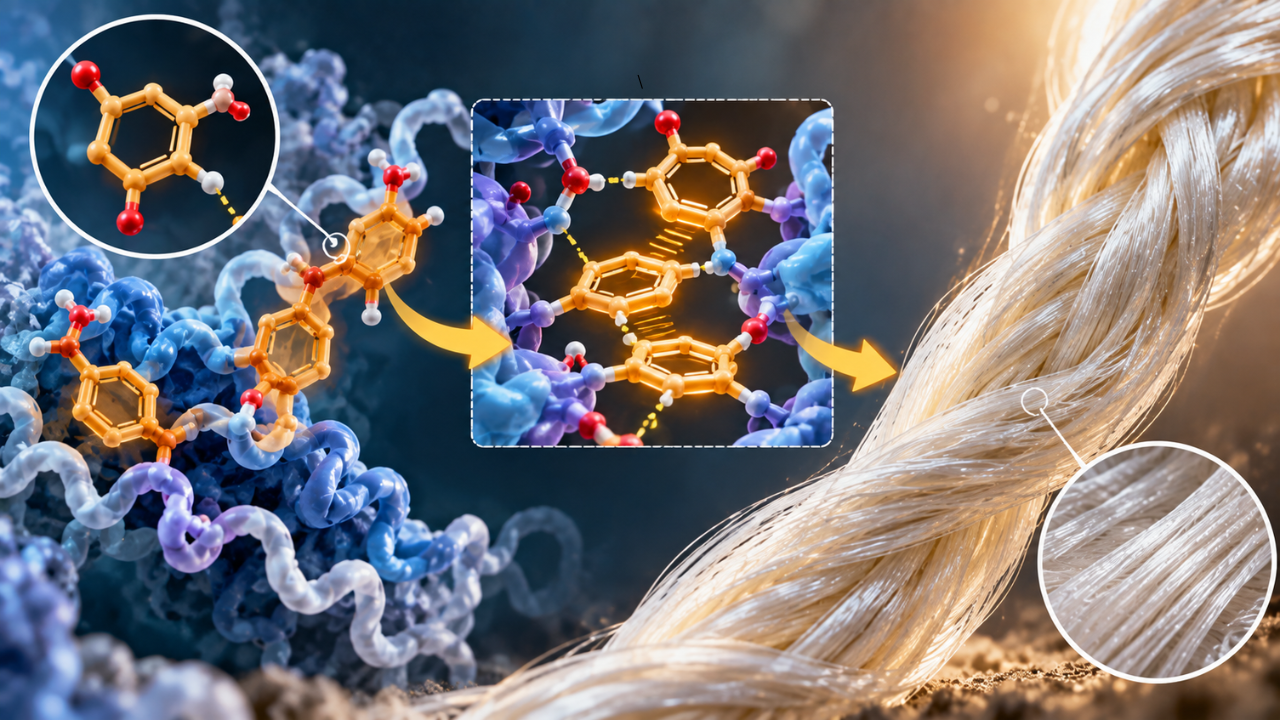
Image AI generated
How engineered silk production increased five to ten times
To test whether the approach could support larger-scale production, the researchers expressed NM-16xFGA-CM in a 2-litre fed-batch bioreactor. The final optical density at 600 nanometres reached 155. The researchers reported a protein expression level of 13.5% and measured a protein titre of 8.0 g/L using a standard curve generated from purified btMfp5-fused 16xFGA proteins with known concentrations.According to the study, this represented a five-to-ten-fold enhancement in protein titre compared with protein titres reported in earlier studies involving recombinant silk proteins. The researchers specifically compared their result with previous work involving a 285 kDa recombinant silk protein containing 96 repeats. They also reported that the fibres produced from their lower-molecular-weight protein had comparable strength and toughness to the recombinant silk materials examined in the study.
How smaller silk proteins improve production and yields
The study explains that producing high-molecular-weight protein-based materials in microbial hosts can lead to lower titres and yields. Although metabolic and genetic engineering approaches can increase protein production, the researchers said these methods have had limited effects on high-molecular-weight protein-based materials. Their alternative approach was to use protein engineering to obtain strong fibres from lower-molecular-weight proteins that could be produced at higher titres and yields.The researchers further reported that their btMfp5-fused proteins could be purified using one-step affinity chromatography, in contrast to some high-molecular-weight recombinant silk proteins that require more complicated purification processes. In the study’s discussion, they described the approach as enabling proteins in the 20–60 kDa range to produce fibres with high tensile strength and toughness, while also supporting the higher protein titre demonstrated in the bioreactor experiment.