Scientists turn one of the world’s hardest-to-recycle plastics into high-performance engine lubricant, giving stubborn PVC waste a valuable second life |
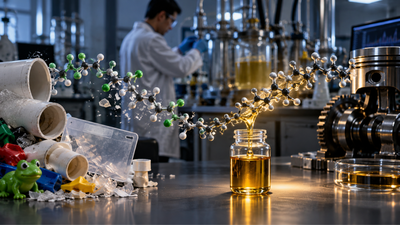
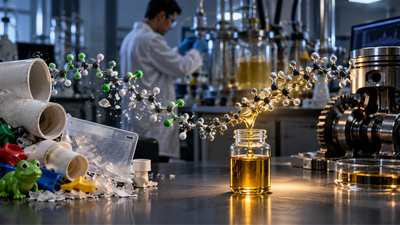
One of the world’s most difficult plastics to recycle could soon have a far more valuable second life. Scientists at Virginia Tech have developed a chemical method that converts polyvinyl chloride, or PVC, into polyalphaolefin, an important material used in high-performance lubricants including engine oil. The approach tackles a longstanding problem with PVC, which is difficult to recycle because of its chlorine content and the variety of additives found in different products. Instead of trying to preserve the original plastic, the researchers break its polymer chains down and transform the resulting molecules into a lubricant material. The work, published in Nature on August 5, could offer a new route for turning problematic plastic waste into a higher-value industrial product while potentially making lubricant production more sustainable.
How scientists turn hard-to-recycle PVC waste into high-performance engine lubricant
The Virginia Tech team, led by chemist and chemical engineer Guoliang “Greg” Liu, developed a process that chemically transforms PVC into polyalphaolefin, or PAO, a class of synthetic hydrocarbon material used as a base component in high-performance lubricants. The process starts by placing PVC in a solvent and adding aluminium trichloride and alpha olefins. The mixture is then heated to about 70°C, or 158°F, for three hours. After the reaction, the researchers extract an oil-like material from the solvent. The significance of the approach lies in its ability to move PVC beyond conventional recycling. Rather than producing another PVC product, the researchers use the plastic as a chemical feedstock for manufacturing a substantially different and potentially more valuable material. The resulting lubricant material was subsequently evaluated through collaborations with researchers outside Virginia Tech.
Why PVC is notoriously difficult to recycle
PVC is widely used in products ranging from plumbing pipes and window components to credit cards and toys, but recycling it presents particular challenges. Unlike many common plastics, PVC contains chlorine within its polymer structure, while commercial PVC products can also contain different combinations of plasticisers, stabilisers, pigments, fillers and other additives. This variation makes it difficult to process discarded PVC as a uniform recycling stream. Large quantities therefore have limited recycling options and can end up being discarded. Liu’s team approached the problem through chemical upcycling, which involves breaking polymer molecules apart and using them to create new chemicals or materials rather than simply remoulding the original plastic. The researchers’ objective was to find a productive destination for PVC waste while extracting greater value from a material that is otherwise challenging to recycle.
A failed experiment helped researchers discover the lubricant route
The lubricant breakthrough emerged after the team’s initial strategy produced disappointing results. Researchers first explored whether the chlorine atoms in PVC could be replaced with other chemical groups to transform the polymer into different materials. The products remained soft and somewhat gooey, however, and did not have the properties the researchers were seeking. That led Liu to consider whether the polymer chains should instead be broken down much further. By continuing to break the PVC chains into smaller molecular segments, the team began producing materials with properties that pointed towards a different application. What initially looked like an unsuccessful attempt to modify PVC therefore became the clue that led the researchers towards lubricant production. Doctoral student Eric Munyaneza Nuwayo led the project, with graduate students Connor S. Thompson and Abby Civiello also contributing to the work.
Researchers tested the material and studied its production potential
The team worked with researchers possessing expertise in several areas to determine whether the material they produced could perform as a lubricant and whether the process might eventually be practical at larger scales. Samples were sent to Ali Erdemir at Texas A&M University for testing, while William Goddard at Caltech contributed computational studies of the chemistry. Virginia Tech researcher Xi Chen carried out economic and production analysis to investigate how the process could potentially be expanded beyond laboratory experiments. These collaborations are important because producing an oil-like material from plastic is only the first step. A useful commercial lubricant must have appropriate performance characteristics, while an industrial recycling process must also be able to handle feedstock, chemical inputs, separation, energy use and production costs. The researchers’ work therefore examines both the chemistry and the possibility of developing the process into a larger-scale manufacturing route.
PVC waste could become a feedstock for more sustainable lubricant production
The researchers say their approach could address two problems at once by creating a new use for difficult-to-recycle PVC while providing an alternative route to lubricant production. The potential environmental benefit comes from treating discarded plastic as a source of valuable chemical feedstock instead of simply disposing of it. However, the development should not be interpreted as meaning that all PVC waste can immediately be converted into commercial engine oil. The process still needs to be assessed for wider feedstocks, scale-up, economic feasibility and its overall environmental footprint. The fate of chlorine and other components present in real-world PVC waste is also an important consideration when evaluating the technology. If these challenges can be addressed, the research could demonstrate how chemical upcycling can turn a problematic plastic waste stream into a useful industrial material, giving PVC a second life in an unexpected place: high-performance lubrication.