Scientists turned discarded crab shells into a biodegradable zinc battery that stayed 99.7% efficient after 1,000 charging cycles |
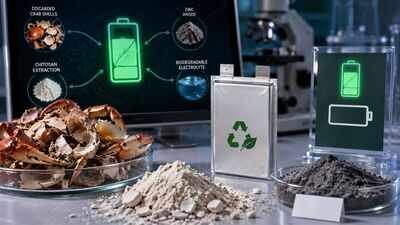
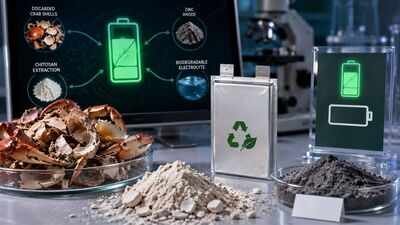
A crab shell left behind after a meal might seem destined for the bin, but scientists have found a very different use for it. Engineers at the University of Maryland have turned material derived from discarded crustacean shells into part of a zinc battery, using chitosan to make its electrolyte. The unusual ingredient is tied to a wider problem in battery technology: what happens to all those materials once a battery has reached the end of its useful life? Some conventional components can persist for centuries, even as batteries are increasingly used to store renewable electricity.In laboratory testing, the new zinc-chitosan battery remained 99.7% energy efficient after 1,000 charging cycles. The chitosan electrolyte also showed a very different fate after disposal, breaking down completely within about five months under the conditions tested. The result is a battery experiment that begins with seafood waste and ends with a question about what batteries leave behind.
How crab-shell waste was turned into a biodegradable battery material
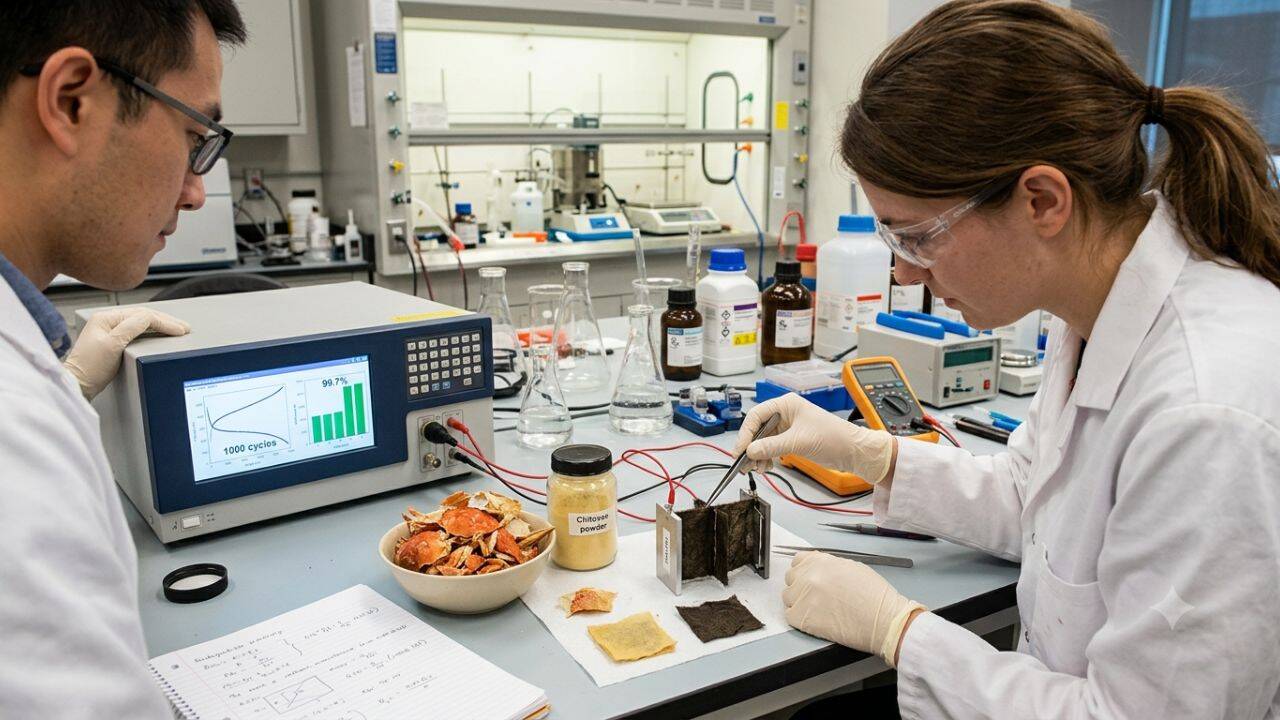
Chitosan is obtained by processing chitin, a structural material found in the shells and exoskeletons of crustaceans. Crabs are one source, but shrimp and lobsters can provide it too. Because these materials are routinely discarded by the seafood industry, they offer an existing source of biological feedstock rather than requiring an entirely new raw material supply.The Maryland team used chitosan to make a gel electrolyte for a zinc battery. An electrolyte is the part of a battery that allows ions to move between its electrodes while the device operates. Conventional battery systems can rely on materials that are difficult to break down, while some electrolytes can also be flammable or corrosive.Here, the researchers were interested in whether a biological material could perform the same basic job while making the battery easier to deal with at the end of its useful life.
The hidden waste that remains when batteries stop charging
The environmental footprint of a battery does not stop when it can no longer hold a charge. Batteries contain several different materials, and some components can persist for very long periods after disposal.Separators are one example. These thin layers keep the positive and negative sides of a battery apart while allowing ions to pass through. Common separator materials include polypropylene and polycarbonate, both of which can take hundreds or even thousands of years to degrade under natural conditions.That creates an awkward contrast. Batteries are increasingly being used to support cleaner electricity and transport, yet parts of the technology itself can create a long-lasting waste problem.The Maryland research focuses on one way of reducing that mismatch.
Why the researchers chose zinc instead of lithium
The battery developed by the researchers uses zinc rather than lithium as its principal metal component. Zinc is relatively abundant in the Earth’s crust and has already been used in several types of battery technology.There are practical reasons for looking at zinc as well. Zinc batteries can be less expensive than some lithium-based systems, and certain zinc chemistries offer safety advantages. The Maryland work was aimed particularly at energy storage rather than at replacing the batteries used in electric cars.Large renewable-energy installations need ways to store electricity generated when the sun is shining or the wind is blowing so it can be supplied to the grid at a later point. A battery designed for this purpose does not necessarily need exactly the same characteristics as one intended to power a vehicle.
Crab-shell material makes part of the battery biodegradable
Inside the Maryland battery, chitosan was used to form a gel electrolyte. The material is biodegradable, giving the battery a component that can break down rather than remaining intact for centuries.The researchers reported that roughly two-thirds of the battery could be decomposed by microorganisms. The chitosan electrolyte itself broke down completely within about five months under the conditions tested.What remained was the zinc component. That is a significant difference from a battery in which several synthetic materials may persist after disposal, although it does not mean the entire battery simply disappears.The work therefore does not turn seafood waste into a complete battery. Instead, it uses one part of that waste stream to replace a component that has traditionally been made from less environmentally degradable materials.
The zinc battery kept its efficiency after 1,000 charging cycles
Biodegradability would have limited value if the battery could not function adequately during use. The Maryland team therefore measured how efficiently its zinc and chitosan system operated over repeated charging and discharging cycles.After 1,000 cycles, the battery recorded an energy efficiency of 99.7% under the researchers’ reported testing conditions. That result suggested that the biodegradable electrolyte could function effectively enough to warrant further investigation for renewable-energy storage.The figure does not mean every future battery made with chitosan would automatically deliver the same performance. Laboratory results depend on the particular materials, construction and testing conditions. Moving from a research prototype to large-scale commercial storage would involve questions about manufacturing, durability, cost and consistency of the raw materials.Still, the experiment demonstrated that biodegradability and useful battery performance did not have to be treated as completely separate goals.
A battery designed with its eventual waste in mind
The idea changes the way the battery is considered. Instead of looking only at how much electricity it can store or how many times it can be charged, researchers can also ask what happens to its components when the battery is no longer useful.That question is becoming harder to ignore as battery production grows. Large numbers of batteries eventually create large amounts of waste, making the choice of materials important well beyond the period when the batteries are operating.Chitosan is particularly interesting because its starting material is already a waste product in many places. Crab, shrimp and lobster shells that would otherwise be discarded can be processed into a useful biological material.The approach also fits into a broader effort to make battery technology less dependent on materials that are difficult to dispose of. It does not solve every environmental issue associated with battery manufacturing, but it addresses one specific part of the problem.
From crab-shell waste to a battery with a different end of life
The Maryland team has described the zinc-chitosan battery as a step towards energy-storage systems in which more of the components can eventually return to the environment without creating persistent waste.The longer-term ambition goes beyond changing one electrolyte. The researchers have also pointed to the manufacturing process itself as an area that needs attention. A material may be biodegradable once a product is discarded, but that does not automatically make the process used to manufacture it environmentally benign.For now, the crab-shell-derived electrolyte provides a relatively unusual example of how waste from one industry can become a material for another. A shell that begins as seafood waste can be processed into chitosan, incorporated into a battery and later broken down by microorganisms.The battery still contains metal, and the technology remains at the research stage. But the experiment offers a different way of thinking about energy storage: not only how a battery performs while it is working, but also what becomes of it afterwards.