
A robot explored the waters beneath 5 Scottish wind turbines and found 121 types of marine life, including possible young deep-water corals
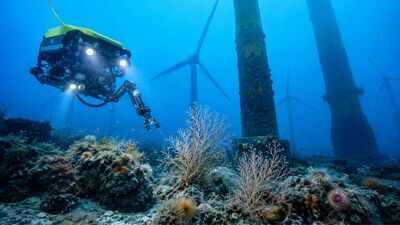
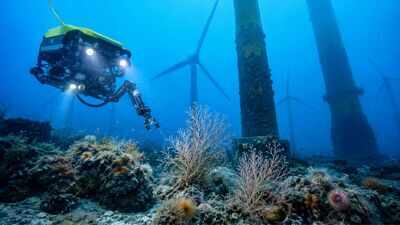
A robotic submersible descended beneath 5 giant floating wind turbines off Scotland, moving around steel structures, cables and anchors that sit as much as 80 metres below the surface. Its high-definition camera recorded a surprisingly busy underwater community at the Hywind Scotland Pilot Park, about 25 kilometres east of Peterhead. Across 41 structures and associated components, the robot’s footage revealed 121 different taxa, ranging from sea stars and sea urchins to mussels, anemones, fan worms, crustaceans and algae. The machine also captured three possible young colonies of deep-water coral growing on an infield cable, although the identification could not be confirmed because no physical samples were collected.The survey offered researchers a rare view of how marine life has settled across floating wind infrastructure, with different organisms occupying different depths and parts of the structures as the artificial habitat developed beneath the North Sea.
Scotland’s Hywind turbines are becoming artificial marine habitats
According to the research published in the European Academy of Wind Energy, titled ‘Artificial hard-substrate colonisation in the offshore Hywind Scotland Pilot Park’, Hywind Scotland sits about 25 kilometres east of Peterhead on Scotland’s east coast. The five turbines became operational in 2017 and occupy waters roughly 100 to 130 metres deep. Unlike conventional offshore turbines, their foundations are not fixed directly into the seabed. Each floating structure is held in position by three suction anchors connected to the turbine by heavy chains. The submerged turbine structures extend about 80 metres below the surface.The seabed around them is mostly sand and gravel, with occasional patches of mixed sediment and boulder fields. That makes the steel infrastructure an important addition to an otherwise largely soft-bottom environment. The turbines, chains, anchors and cables provide firm surfaces that organisms can attach to and occupy. For marine biologists, the arrangement also offers a chance to watch an artificial habitat develop in deep offshore water.
Underwater ROV reveals marine life thriving around Scotland’s turbines
The research published revealed that the inspection was carried out using a work-class remotely operated vehicle, or WROV, fitted with an HD colour camera and lights. The machine moved slowly around the infrastructure while marine biologists watched the live video feed and recorded organisms, colonisation and changes in the underwater community.The survey included the turbine substructures themselves, along with mooring lines, suction anchors and infield cables. Some sections received especially close inspection, with the ROV moving to within less than a metre of the structures when conditions allowed. The resulting footage was later reviewed in detail, allowing individual animals to be counted and the coverage of attached organisms to be assessed. The ROV could follow the structures from near the surface towards depths approaching 80 metres without putting divers into an environment that would have made repeated surveys difficult.
Scotland’s floating turbines attract a surprisingly rich mix of marine life
The survey identified 121 taxa belonging to 11 phyla. They included 48 epifouling taxa, organisms growing on the artificial surfaces and 73 mobile taxa. The researchers estimated that nearly 16,000 individual mobile animals were recorded, although the number of sea stars and sea urchins was probably underestimated because they were sometimes present in such numbers that counting every individual became difficult.The most abundant mobile taxon was Asteroidea, probably the common sea star Asterias rubens, followed by small sea urchins. Crustaceans were also widespread, with squat lobsters, brown crabs, Norway king crabs and lobsters recorded around the structures.Fish were using the area too. Flatfish, haddock and ling were observed near the seabed, while squid, octopuses and rays also appeared in the survey footage. The artificial structures were therefore being used by both organisms that remained attached to them and animals that moved across or around them.
From kelp to anemones: Scotland’s turbines develop distinct underwater zones
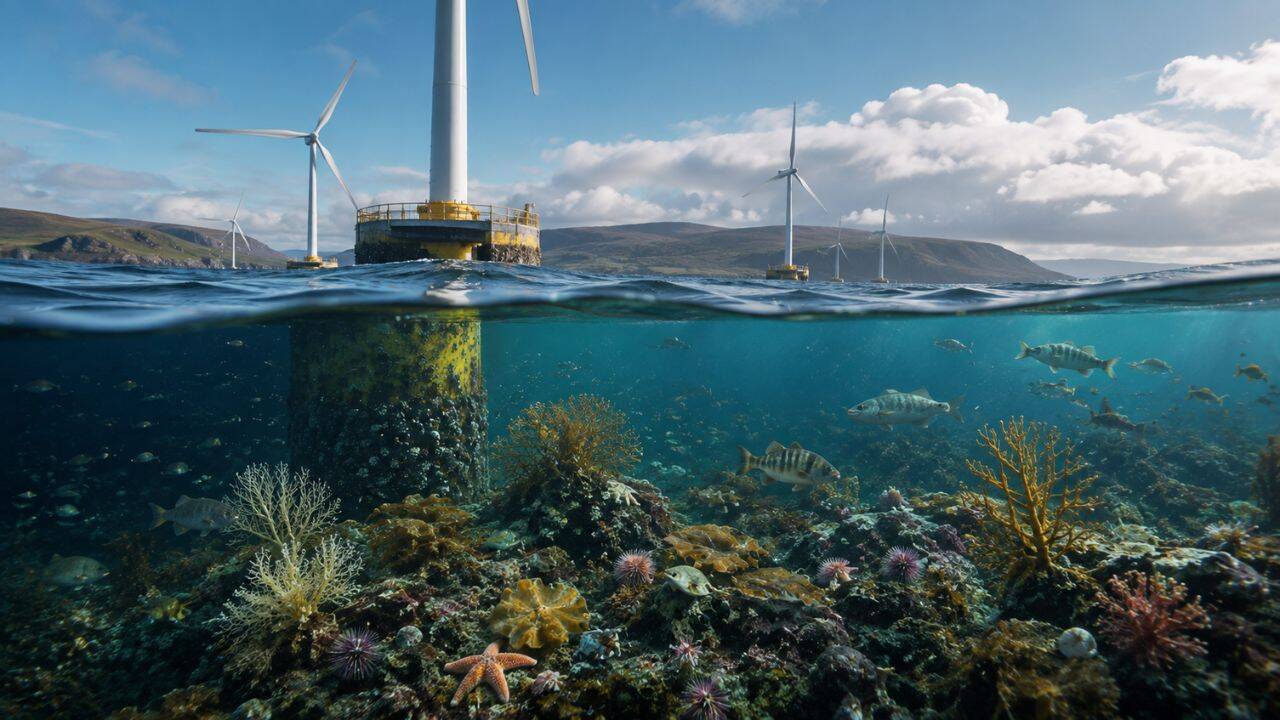
Plumose anemones (Metridium senile) and tube-building fan worms (Spirobranchus sp.) dominated the lower and middle sections, roughly 80–20 metres deep. Near the surface, kelp and other brown algae increased, alongside blue mussels (Mytilus group).Sea stars and sea urchins occurred at various depths, with their highest numbers around 10–25 metres. Nudibranchs and squat lobsters were generally found below 40 metres. Mooring lines showed distinct patterns: near the seabed, Ross worms (Sabellaria spinulosa) and Ectopleura larynx dominated; higher sections had more Spirobranchus, while upper chains carried barnacles, plumose anemones and Ectopleura.On suction anchors, hydroids dominated the upper surfaces, while Spirobranchus, Ectopleura and barnacle patches covered the sides. Exposed infield cables were heavily colonised by barnacles, while buried sections had none.Researchers also recorded three possible young colonies of deep-water coral Desmophyllum pertusum, formerly Lophelia pertusa, along an infield cable between turbines HS01 and HS04. One, photographed on buoyancy modules at about 73.5 metres, measured around 20 centimetres across. The colonies remain unconfirmed because identification was based only on visual inspection.
Scotland’s floating turbines are becoming living, changing ecosystems
The turbines were not simply colonised and then left unchanged. Researchers compared observations from 2018 and 2020 to examine how the marine growth had developed. The amount of surface covered by growth generally increased, although the picture was more complicated when thickness was measured. On turbine structures, for example, changes in coverage were not statistically significant for either hard or soft growth, while the thickness of hard growth decreased overall and soft growth increased. The suction anchors and mooring lines showed their own patterns of change.