
How concretisation is turning cities into monsoon flood traps | India News
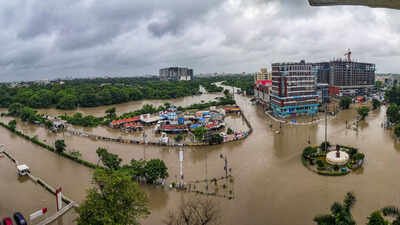
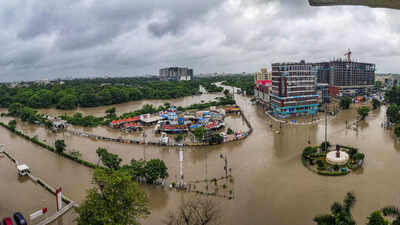
Every monsoon, the pattern repeats across cities.Roads disappear under water, traffic comes to a standstill, trains are delayed and water enters residential colonies, offices, parks, schools and hospitals. Potholes become difficult to spot, drains overflow and even a few hours of heavy rain can disrupt daily life.Extreme rainfall and inadequate drainage are often blamed. But researchers and government agencies have increasingly pointed to another factor: the rapid concretisation of urban spaces.As cities expand, open land, wetlands and vegetation are replaced by buildings, roads, pavements and parking areas made of concrete, asphalt and other impermeable materials. This reduces the ability of the soil to absorb rainwater.Water that would once have seeped into the ground and recharged aquifers instead flows rapidly over hard surfaces and enters stormwater drains. During intense monsoon spells, the volume of runoff can exceed the capacity of these drains, leading to waterlogging and urban flooding.
When concrete turns rainfall into runoff
Urban flooding is no longer seen only as a consequence of unusually heavy rain. Studies have linked it to the way cities have expanded, often at the cost of lakes, wetlands, vegetation and open soil.Unchecked construction, encroachment on water bodies and widespread cementisation have altered the natural movement of water through urban landscapes. Impermeable surfaces increase the speed and volume of runoff, while the loss of lakes and wetlands reduces the space available to store excess rainwater.The result is that even when cities add more drains, water can reach them faster than the system is equipped to carry it away.
Bengaluru: Less vegetation, fewer lakes and faster runoff
A 2017 study by the Centre for Ecological Sciences at the Indian Institute of Science found that Bengaluru’s urban area had expanded by more than 1,000 per cent since the 1970s. Over the same period, vegetation cover declined by nearly 88 per cent and water bodies by around 79 per cent.The study estimated that nearly 78 per cent of Bengaluru’s surface had become impermeable, leaving limited space for rainwater to seep into the soil.
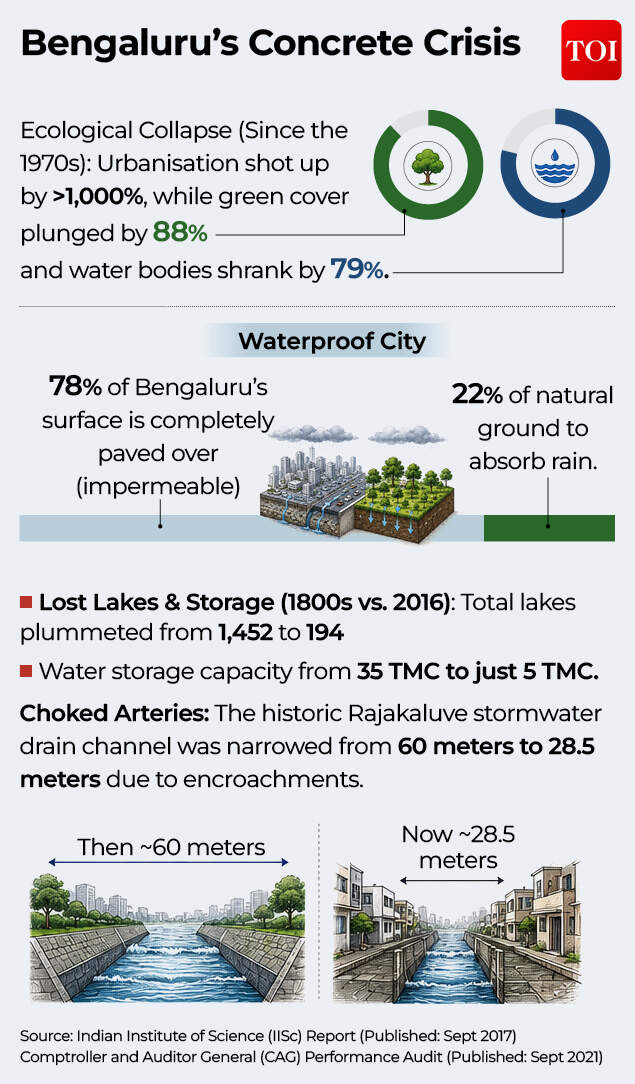
Bengaluru’s Concrete Crisis
Rainfall that previously recharged groundwater now flows over concrete and asphalt into stormwater drains, increasing both the volume and speed of surface runoff.The researchers also examined the effect of concrete-lined drains. Such drains can move water faster than channels lined with soil and vegetation. But concrete prevents infiltration and reduces surface friction, allowing large volumes of water to reach downstream areas in a shorter period.According to the study, this approach can shift flood risk from one part of the city to another instead of addressing it.Researchers also found that the traditional rajakaluve stormwater channel connecting City Market with Bellandur Lake had narrowed from about 60 metres to 28.5 metres because of encroachments and physical alterations.The findings were subsequently cited in the Comptroller and Auditor General’s September 2021 performance audit on the management of stormwater in Bengaluru.The CAG found several gaps in the city’s stormwater management, including discrepancies in the reported length of drains and the absence of a complete inventory of tertiary drains.The audit also documented the decline of Bengaluru’s water bodies. Within the city’s present-day area of 741 square kilometres, their number fell from 1,452 in the early 1800s to 194 in 2016.Their combined storage capacity declined from around 35 thousand million cubic feet, or nearly 991 billion litres, to about 5 thousand million cubic feet, or approximately 142 billion litres.This loss of storage capacity has left the city with fewer natural spaces to hold excess monsoon water.
Delhi: River flooding and local waterlogging
Similar concerns were raised in the National Institute of Disaster Management’s report, YamunaUrban Floods in Delhi with Focus on July 2023 Event.According to the report, Delhi’s urban land cover increased from 46.2 per cent in 1991 to 75.1 per cent in 2011. Separately mapped built-up area rose from around 20 per cent in 1985 to more than 52 per cent by 2018.
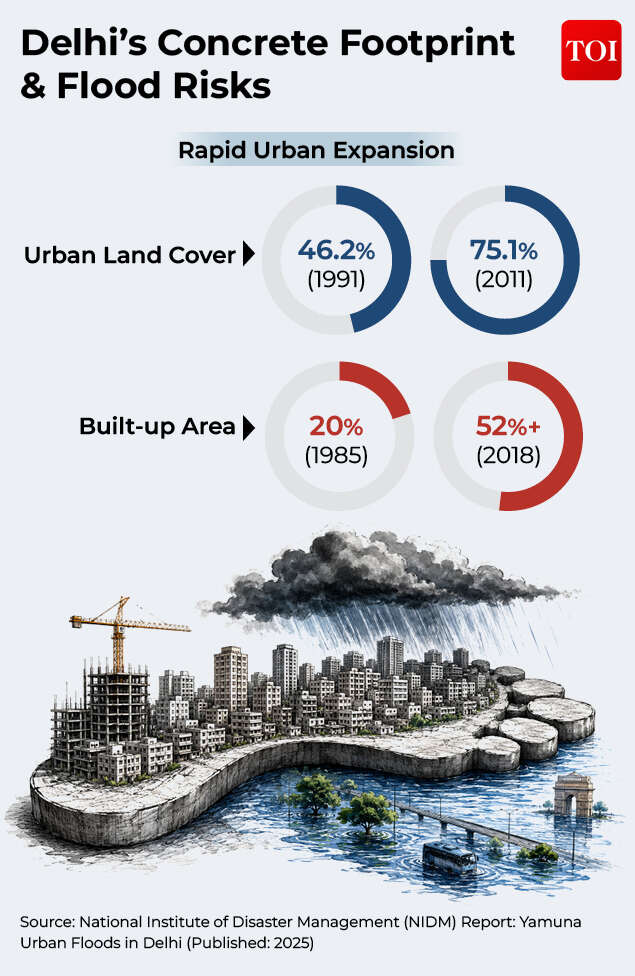
Delhi’s concrete footprint
The NIDM said the increase in impermeable surfaces had reduced the time taken for rainwater to reach drains and the Yamuna. This produced higher peak flows and increased the possibility of flash flooding, including during spells of rainfall that may not otherwise have caused widespread disruption.The report distinguished between two forms of flooding in the capital.The first occurs when high water levels in the Yamuna push river water back into Delhi’s drainage network. The second is local urban flooding, in which runoff from roads, pavements, colonies and other built-up areas enters drains faster than they can carry it away.The NIDM identified concretisation, pressure on drainage infrastructure and encroachment on the Yamuna floodplain among the factors that aggravated the July 2023 floods.
Mumbai: Flood mitigation alongside expanding concrete cover
In Mumbai, flood-control spending has increased, but so has the city’s built-up area.Brihanmumbai Municipal Corporation had invested in river rejuvenation, pumping stations, hazard mapping and weather forecasting as part of its flood-mitigation measures.At the same time, redevelopment and infrastructure projects continued to add impermeable surfaces across the city.Around 38 per cent of the BMC’s annual budget had been set aside for climate-related measures, with a substantial share directed towards flood and water management.However, redevelopment projects were expected to add nearly 344 million square feet of built-up area. Officials quoted in the report said construction and redevelopment were progressing faster than flood-mitigation and environmental-restoration measures.
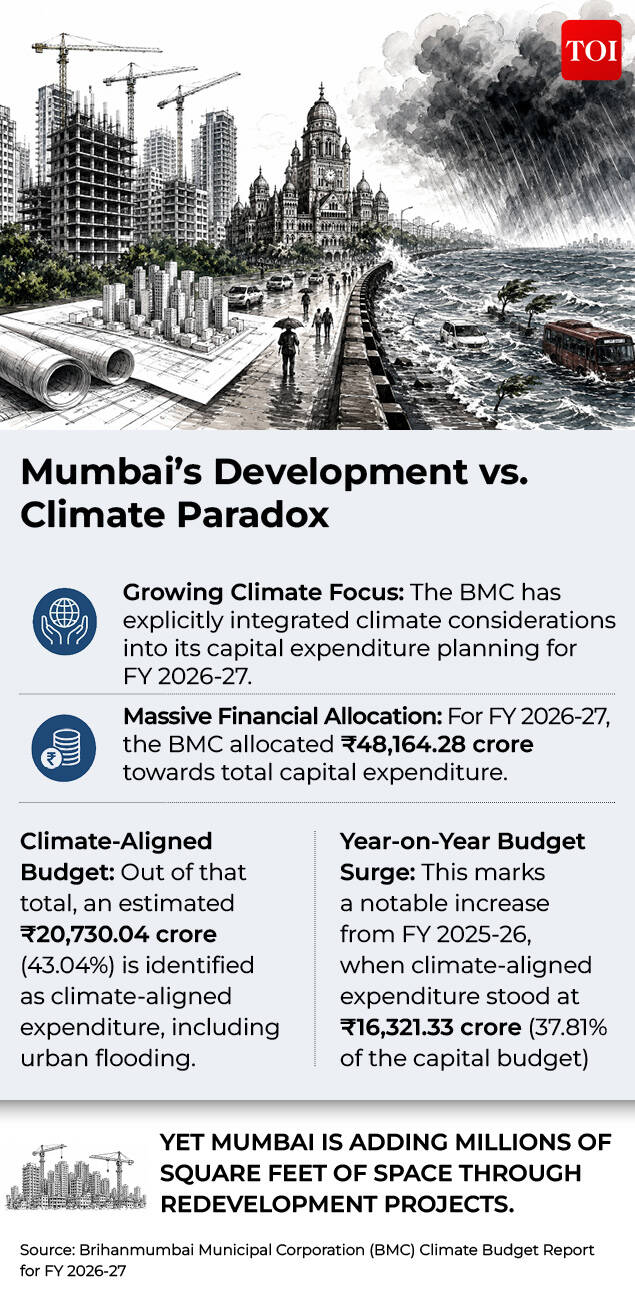
Mumbai’s development vs climate paradox
Mumbai has also pursued widespread concretisation of roads as part of its response to potholes and road deterioration. While concrete roads may offer greater durability, expanding hard surfaces without adequate water-absorption measures can increase stormwater runoff.The BMC’s climate budget report for 2026-27 provides an allocation of nearly Rs 48,164 crore, of which 43 per cent has been earmarked for five climate-related risks, including urban flooding.
What the NGT has directed
In an order dated May 21, 2025, the National Green Tribunal issued directions to local bodies and development authorities across India against indiscriminate concretisation during urban development and the construction of roads, berms and footpaths.The tribunal called for the use of permeable or semi-permeable surfaces and directed authorities to preserve non-concretised space around trees.It said a Uttar Pradesh government order dated March 23, 2018, should serve as the default guideline for states and Union territories that had not framed their own rules.The guidelines recommend permeable paving instead of continuous concrete surfaces, restrictions on paving around lakes, ponds, parks and roadside green areas, and a minimum one-metre de-concretised area around trees.They also call for rainwater-harvesting systems in larger developments and groundwater-recharge structures, including ponds and recharge pits, in new layouts.
Cities begin de-concretisation efforts
Some municipal authorities have begun implementing measures aimed at restoring open soil and protecting water bodies.Ahead of World Environment Day in 2025, Bengaluru ordered the removal of concrete, cement and stone blocks within a one-metre radius of roadside trees.The city has also used drone surveys, geographical information system mapping and digital lake records to identify encroachments and support removal drives.In 2024, the Municipal Corporation of Delhi said it had de-concretised the area around 24,000 of the approximately 41,000 trees identified within its jurisdiction.The Delhi Development Authority has also carried out demolition drives against unauthorised structures on the Yamuna floodplain following directions from the Delhi High Court and the NGT.Such measures, however, remain limited when compared with the pace at which Indian cities continue to build roads, housing projects, commercial complexes and other infrastructure.
More drains alone may not be enough
Concrete remains central to urban construction because it is durable, widely available and capable of supporting heavy loads. It can be moulded into different forms and does not burn, rot or rust.The challenge is not to eliminate concrete entirely, but to avoid using it where permeable alternatives are possible.The NGT has recommended materials such as stabilised soil, coarse sand, fly-ash bricks, stones and perforated tiles for pedestrian and open areas. These materials allow at least some rainwater to enter the ground.Where concrete cannot be avoided, measures such as bioswales, rain gardens, recharge pits and soak pits can be incorporated into roads and drainage systems. These structures slow the flow of water and allow part of it to seep into the soil instead of sending the entire volume directly into drains.Urban flooding cannot be addressed only by widening drains or installing more pumps while the surrounding landscape continues to harden.As monsoon rainfall becomes more difficult to manage, cities will also have to reconsider how their roads, pavements, open spaces and neighbourhoods are designed. Restoring wetlands, protecting drains and floodplains, and creating more permeable surfaces will be as important as building new drainage infrastructure.