
Worth more standing: India’s forests are a $2.5-trillion asset we keep forgetting to count | India News
Picture a bank vault the size of Madhya Pradesh. Inside it sits not gold bullion or govt bonds, but clean water, breathable air, pollination services, flood barriers, carbon blocks, and medicinal plants — a portfolio of natural assets worth roughly $2.5 trillion every single year. Now imagine that this vault does not appear on any national balance sheet, that its contents are routinely given away for free, and that the state periodically sanctions its demolition to make room for mines and motorways.That, in essence, is what India does with its forests. A new peer-reviewed study published in Environmental and Sustainability Indicators has — for the first time at a comprehensive national scale — put hard numbers on what India’s forests are actually worth. The findings should disturb every finance ministry official, every forest officer, and every citizen who has wondered why the govt keeps approving the conversion of green cover into concrete.
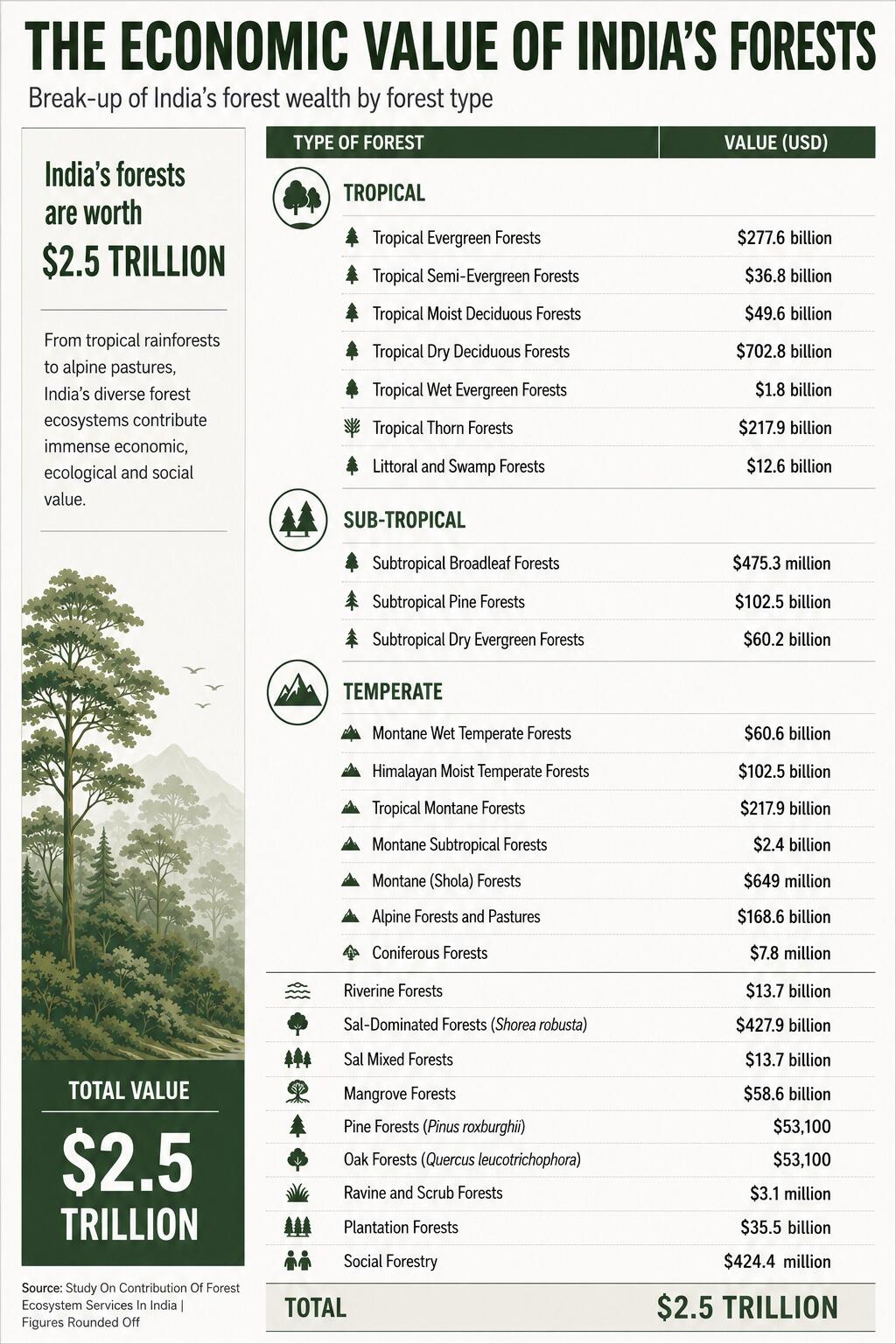
Taming a jungle of dataThe study by M Balasubramanian from the Institute for Social and Economic Change (Isec) along with colleagues from the Indian Council of Forestry Research and Charles Darwin University in Australia, drew on 45 valuation studies published between 2000 and 2024. Every estimate was standardised to 2023 US dollar prices. This was challenging given that some studies valued a single medicinal plant species in one forest patch while others attempted national-level assessments.“We applied meta-regression analysis, a technique borrowed from several research that pools results across heterogeneous studies and uses statistical controls to identify what is really driving the variation in reported values. The covariates included GDP per capita, population density, forest cover, the type of ecosystem service being valued, and the valuation method employed,” Balasubramanian told TOI.The model explained 74% of the variation in reported total ecosystem service values, a respectable fit for such a noisy dataset. The result: India’s forests deliver ecosystem services worth an average of $31,001 per hectare per year. Across the country’s roughly 8,27,000 sqkm of forest and tree cover, that compounds to approximately $2.5 trillion annually. For context, India’s entire GDP in 2023 was about $3.7 trillion. The forests generate invisible wealth equivalent to nearly two-thirds of the formal economy, and virtually none of it is counted.Which forests carry the most weight?Not all forests are created equal, and the study breaks the numbers down by forest type in ways that should directly inform land-use decisions.Tropical dry deciduous forests, the extensive, seasonally leafless woodlands that blanket large swathes of central and peninsular India, top the league table at approximately $703 billion per year. Their sheer extent is the primary driver: these forests cover nearly 2,81,000 sqkm. Per hectare, their value has actually risen from $22,400 in 2019 to $25,045 in 2023, even as their area has contracted.Tropical thorn forests, the scrubby semi-arid woodlands of Rajasthan and the Deccan, punch well above their ecological weight at a per-hectare value of over $1,58,000, largely because of the irreplaceable services they provide in preventing soil erosion and desertification in regions with no alternative vegetation. Alpine forests and pastures in the Himalayan zone are valued at $1,11,539 per hectare, reflecting their central role in regulating water flows for rivers that irrigate the breadbasket of northern India. Mangrove forests, perennially under threat from coastal development, contribute $58.5 billion per year in services that include cyclone buffering, fishery nurseries, and coastal erosion prevention. The 2020 Cyclone Amphan, which caused catastrophic damage to coastal Odisha and Bengal, offered a live demonstration of what happens when these natural defences are eroded.Invisible services that matter mostOne of the study’s most important findings concerns which category of services contributes most to total forest value. The instinctive answer — timber and other products people can sell — turns out to be wrong.The meta-regression shows that regulating services carry the strongest statistical relationship with reported total ecosystem values. Carbon sequestration, water purification, flood regulation, climate stabilisation, pollination: these functions are worth more, in aggregate, than the timber and non-timber forest products that typically drive forest policy. “Cultural services like ecotourism, spiritual significance, recreation, the preservation of biodiversity as intrinsic heritage, come second by our standardised coefficients, ahead of provisioning services,” Balasubramanian said.This matters because current policy is largely calibrated to the inverse priority. Compensatory Afforestation Fund payments for diverted forest land are calculated on formulae that have historically struggled to capture regulating and cultural service values. The Net Present Value charged for forest diversion similarly under-represents the full economic cost.GDP paradox & population pressureThe study’s statistical model surfaces a striking paradox at the heart of India’s development trajectory. Higher GDP is positively associated with reported forest ecosystem service values, but the relationship is not statistically significant. The authors suggest the link likely operates through increased investment in conservation and green infrastructure rather than any automatic market mechanism.Population density tells a darker story. A 1% increase in population density is associated with an 11.3% decrease in the value of forest ecosystem services, a large and statistically meaningful effect. The mechanism is direct: denser populations mean more agricultural encroachment, more illegal felling, more fragmentation, more infrastructure cutting through forest corridors. India’s population density of 464 people per sqkm, against a global average of roughly 60, places it under enormous structural pressure on its remaining forests.Nor does forest cover alone guarantee value. The study finds no statistically significant relationship between the quantity of forest cover and reported ecosystem service values. What matters is quality: forest health, biodiversity richness, management regime, and the specific services each forest type provides. “A monoculture plantation counts as forest cover in official statistics but delivers a fraction of the ecosystem services of a natural mixed-species stand,” Balasubramanian explained.Accounting gap & how to close itThe core policy argument of the paper is straightforward: until the economic value of forest ecosystem services is incorporated into national income accounting and project-level appraisal, India will continue to systematically under-price decisions that destroy natural capital.The authors call for adoption of the System of Environmental-Economic Accounting (SEEA) framework, which the UN has developed precisely for this purpose and which countries including the UK, Netherlands, and Australia have begun implementing. In practical terms, this would mean that when a state govt proposes to divert 500 hectares of tropical dry deciduous forest for a new expressway, the economic appraisal would need to include the foregone $12.5 million in annual ecosystem services — permanently.“India is not starting from zero. CAMPA, the Green India Mission, REDD+ projects, and various state-level Payment for Ecosystem Services experiments all represent institutional infrastructure that could be scaled and sharpened. What is missing is the systematic valuation evidence to anchor these schemes, evidence that our study now begins to provide,” Balasubramanian said.India’s forests are not a cost to be managed. They are an asset to be stewarded — one generating $2.5 trillion in annual returns that the nation’s accountants have yet to learn to see.