
Humanoid robots perform live surgery for the first time in world-first medical breakthrough |
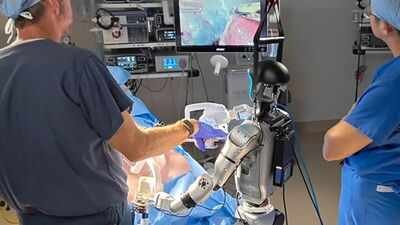
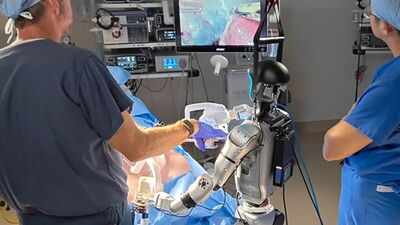
Robotic surgery has become a familiar part of modern healthcare, but the machines used in operating theatres are usually purpose-built systems designed for a narrow set of tasks. humanoid robots, despite rapid advances in recent years, have largely remained outside the surgical environment. That has now begun to change. A team of engineers and surgeons at the University of California San Diego has demonstrated that teleoperated humanoid robots can successfully perform live minimally invasive surgery during preclinical trials. According to the study published in Nature on 8 July 2026 titled “In vivo feasibility study of humanoid robots in surgery”, it marks the first time humanoid robots have completed such procedures on living subjects and offers an early glimpse of how future operating rooms could look if these systems continue to mature.
Meet Surgie : The humanoid robot built for hospitals’ operating rooms
Most robotic surgery platforms found in hospitals today are large, specialised machines built specifically for procedures such as laparoscopic operations. They provide surgeons with highly precise control, but they are expensive, occupy substantial space and require dedicated infrastructure.As per the University of California San Diego, the project took a different route. Instead of adapting a conventional surgical robot, the team developed a teleoperation framework around general-purpose humanoid robots. Standing roughly five feet tall and weighing about 60 pounds, the robots were designed to work with standard laparoscopic instruments rather than custom-built surgical hardware.Researchers nicknamed the system “Surgie”. During testing, surgeons controlled the robots remotely via a teleoperation interface, enabling the machines to mimic human movements and perform delicate surgical procedures.The authors described the work as an assessment of whether current humanoid technology can meet the precision, control, and safety demands associated with minimally invasive surgery.
Humanoid robots complete live gallbladder removal surgeries
The preclinical trials involved two separate gallbladder removal operations carried out on large non-primate mammals. In one procedure, a humanoid robot worked alongside a human surgeon, creating a human-robot surgical team. In the second operation, two teleoperated humanoid robots worked together, each handling laparoscopic instruments while performing the surgery.Both procedures were completed successfully. The achievement is significant because it moves humanoid robots beyond laboratory demonstrations and simulated surgical exercises. According to the study, the project included extensive testing that ranged from controlled bench experiments and dry-lab evaluations to live surgical procedures, allowing researchers to assess technical performance across increasingly realistic conditions.Rather than focusing solely on whether the robots could complete individual tasks, the team sought to measure how close current humanoid systems are to the standards expected in real surgical environments.
How humanoid robots could expand access to surgery worldwide
The motivation behind the project extends beyond robotics research. Healthcare systems in many countries are facing shortages of trained surgical staff while demand for treatment continues to grow. This imbalance can lead to delays, reduced access to specialist care and widening disparities between urban medical centres and remote communities.Michael Yip, a professor in UC San Diego’s Department of Electrical and Computer Engineering and one of the study’s senior authors, said teleoperated and eventually autonomous humanoid systems could help expand access to surgical care in locations where specialists are difficult to recruit.“Remotely operated and autonomous humanoid robots have real potential for amplifying access to critical surgeries to which patients would otherwise not have access,” Yip said. “This can help address the healthcare crisis not only in the United States, but also worldwide.”Unlike large robotic surgery platforms that often require specially configured operating theatres, humanoid robots can move through spaces designed for people. Researchers believe this flexibility could make them easier to deploy in smaller hospitals, temporary medical facilities and emergency response settings.
Humanoid robots integrate seamlessly into existing operating rooms
One unexpected outcome of the trials was how naturally the humanoid robots integrated into a standard surgical workspace.While adapters had to be developed so the robots could hold conventional instruments, the machines were able to operate within an existing operating-room environment without the extensive modifications commonly associated with dedicated robotic systems.Nikita Thareja, a general surgery resident at the UC San Diego School of Medicine and co-author of the study, said the team was surprised by how effectively the robots adapted to existing workflows.The researchers argue that this compatibility could become one of the technology’s strongest advantages. Rather than redesigning hospitals around robotic platforms, hospitals could potentially introduce humanoid assistants into environments that already exist.
Can humanoid robots match the precision of surgical robots
A central question surrounding humanoid surgery has been whether a general-purpose robot can achieve the level of precision required for delicate procedures.According to Shanglei Liu, assistant professor of surgery at UC San Diego and one of the senior authors, the teleoperated system demonstrated surgical accuracy comparable to that achieved through established robotic surgery platforms.Yet the technology remains far from routine use. The procedures took considerably longer than surgeries performed using mature robotic systems because the robots required multiple recalibrations during operations. There were also technical challenges involving latency, the delay between a surgeon’s movements and the robot’s response, particularly when considering future long-distance teleoperation.As per the study, these limitations are important areas for improvement. While current humanoid platforms demonstrated feasibility, the authors emphasised that further advances in control systems, reliability and safety will be required before any clinical deployment becomes realistic.
Humanoid robots could take on multiple roles in hospitals
The UC San Diego team does not necessarily envision humanoid robots serving only as robotic surgeons.Because the machines possess mobility and can interact with human-designed environments, researchers see them taking on a wider range of duties inside hospitals. A humanoid assistant could transport equipment, retrieve instruments, prepare workspaces or help manage operating-room logistics before and after procedures. According to Yip, one long-term objective is the development of an autonomous surgical assistant capable of supporting healthcare teams where staffing shortages limit access to treatment.The vision is not of robots replacing medical professionals but of integrated teams in which human clinicians and robotic systems share responsibilities according to their strengths.
Which feature of humanoid robots do you find most appealing for surgical use?
3k+ users shared opinion today
5k+ users already voted today
3k+ users shared opinion today