Nasa unveils $600 million for new Lunar base missions for 2028: Inside the plan to build a lasting presence on the Moon |
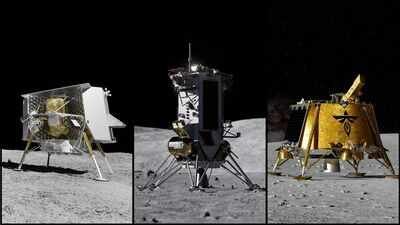
Nasa has taken another step towards building a permanent human presence on the Moon by awarding almost $600 million in fresh contracts for a new series of robotic lander missions. Rather than focusing on a single spacecraft, the agency is spreading the work across several commercial partners, continuing its strategy of using private companies to transport scientific equipment and technology to the lunar surface.The four new missions are expected to launch in late 2028 and will support the wider Moon Base programme, which is intended to establish the foundations for sustained exploration beyond Earth. Alongside the contracts, Nasa has outlined several future projects, including a possible lunar rover inspired by its successful Mars vehicles and new opportunities for industry to contribute technologies that could eventually support astronauts living and working on the Moon.
Nasa partners with private firms to scale up Moon missions
The newest contracts were issued through the CLPS program run by Nasa, where commercial firms could deliver a scientific payload while working on their own landing technology on the Moon.“These new awards to our commercial partners, totaling nearly $600 million to land more missions on the Moon with science payloads, demonstrate our commitment to accelerating our effort to build a long-term presence on the lunar surface, and give us more opportunity to develop the skills we need to prosper there,” said Lori Glaze, associate administrator for the Human Spaceflight Mission Directorate at Nasa Headquarters in Washington.Astrobotic Technology was granted the highest amount of money in contracts for the total sum of $297.9 million for two different missions. Firefly Aerospace was granted a contract for one mission for the amount of $144.2 million. The contract for one mission from Intuitive Machines was issued for $148.3 million.Rather than introducing completely new spacecraft, all three companies will fly updated versions of landers that have already been tested or used in previous lunar missions. Nasa believes refining proven designs will allow missions to be scheduled more frequently while reducing technical risks through experience gained from earlier flights.The four deliveries announced this week increase Nasa’s planned commercial lunar surface missions to 17, reflecting the agency’s intention to establish a regular transport system rather than relying on occasional flagship missions.
How Nasa is building experience before human return to the Moon
Nasa says these robotic flights are about far more than simply delivering scientific instruments. Each mission is intended to expand practical knowledge of operating on the lunar surface before larger infrastructure and eventually human crews begin arriving.Engineers want repeated opportunities to test landing systems, examine how different spacecraft interact with the Moon’s dusty environment, and improve mission reliability through real operational experience.By placing similar equipment at different landing sites over several years, scientists hope to build a broader picture of conditions across the Moon instead of relying on isolated observations from individual missions.
Studying dust, navigation, and radiation through identical experiments
The three identical Nasa payloads on each of the four landing modules will measure the same data in various areas of the Moon.The first payload that will be carried aboard will be the Stereo Camera for Lunar Plume Surface Studies, or SCALPSS. This payload will take high-resolution photos while landing. Through the use of several cameras, 3D images will be captured and studied in order to study how the rocket plumes interact with the dust on the Moon’s surface before landing. It will aid in understanding how the dust will behave for upcoming landings of bigger spacecraft at close distances.Another payload is the Laser Retroreflector Array, which is a small and passive device consisting of quartz cubes arranged in an aluminium structure. It needs no power source but can reflect the laser beams aimed at it from orbital spacecraft or upcoming landers. This will assist Nasa in mapping out reference points that future missions will use for navigation purposes.The third payload, the Linear Energy Transfer Spectrometer, focuses on radiation. By measuring the energy carried by incoming space particles, it will provide detailed information about the radiation environment encountered during lunar missions. Those measurements are expected to guide the design of safer spacecraft and habitats while helping mission planners prepare for astronauts spending longer periods on the Moon.Nasa is also examining whether extra scientific equipment could be added to some of the landers before launch.
PROMISE: NASA’s next step in lunar polar exploration
Alongside the new lander contracts, Nasa has revealed early plans for another major project known as PROMISE, short for Polar Rover for Observation, Mapping, and In-Situ Exploration.Rather than designing an entirely new vehicle from scratch, engineers are considering an engineering development version based on technologies developed for the Perseverance rover and Curiosity rover missions.If approved, the rover would explore the lunar polar region, studying both the surface and material beneath it while investigating resources that could support future human exploration. Scientists are still defining exactly what tasks PROMISE would undertake and how it would fit into the wider Moon Base programme.
How Nasa plans to scale up lunar capabilities beyond early missions
Nasa’s plans extend well beyond these four lander missions. The agency intends to invite industry proposals over the coming months covering several new areas of lunar infrastructure.Future competitions are expected to include landers carrying new scientific payloads, demonstrations of electrical power and avionics technology, and an optical imaging system for the Moon’s south polar region.Nasa also wants companies to propose communication and navigation relay satellites that could improve links between spacecraft operating on the Moon and controllers on Earth. Such a network would become increasingly important as more missions begin operating simultaneously across different regions of the lunar surface.