Brown tree snakes reached Guam hidden in military cargo during World War II, and it triggered an ecological collapse that wiped out nearly all native birds and slashed tree seedling growth by up to 92% |
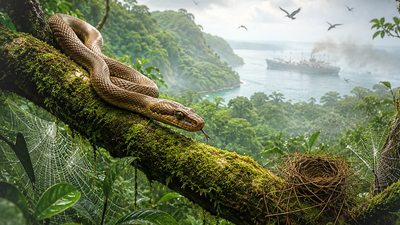
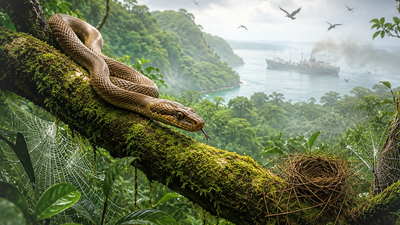
An invasive snake that likely arrived on Guam hidden inside military cargo after the Second World War went on to transform the island’s ecosystem in ways scientists are still trying to understand. The brown tree snake, native to parts of Australia, Papua New Guinea and nearby islands, found an environment unlike any it had encountered before. With abundant prey and no native tree-climbing snakes competing for resources, its population expanded rapidly. Over the following decades, the snake drove nearly all of Guam’s native forest birds to extinction in the wild, setting off a chain reaction that reshaped forests, altered food webs and produced ecological consequences that continue to unfold more than 70 years later.
How brown tree snakes turned Guam into a silent forest
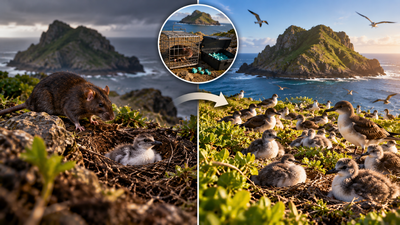
Long before the brown tree snake arrived, Guam’s forests echoed with the calls of native birds that had evolved in remarkable isolation. As the largest island in the Mariana Islands in the western Pacific Ocean, Guam had no native tree-climbing snakes, meaning its birds had never evolved defences against such predators. Many species built exposed nests in trees, making eggs, chicks and even adult birds exceptionally vulnerable once the invasive snake appeared.The invasion unfolded quietly but relentlessly. Under the cover of darkness, brown tree snakes climbed trees and raided nests, feeding on eggs, hatchlings and even adult birds that had never evolved to recognise them as predators. Night after night, the attacks continued, and bird populations began to collapse. Over the following decades, 10 of Guam’s 12 native forest bird species disappeared from the wild, while the remaining two survived only through intensive conservation programmes and captive breeding. Species such as the Guam flycatcher vanished from the island altogether, while the Guam rail and Guam kingfisher escaped extinction only because of extraordinary human intervention. Forests that once echoed with birdsong gradually fell silent, earning Guam the haunting nickname “the silent forest” among ecologists.The disappearance of birds reshaped the ecosystem in ways that extended far beyond wildlife. Birds controlled insect populations, pollinated flowering plants and dispersed the seeds of dozens of native tree species. Once they disappeared, many of these natural processes began to unravel, setting the stage for ecological changes that scientists continue to study today.
How a World War II stowaway reached Guam
Scientists believe the brown tree snake (Boiga irregularis) was accidentally transported to Guam in the late 1940s aboard military cargo and equipment shipped to the island after World War II. Although the species was first officially recorded in the early 1950s, researchers believe breeding populations had already become established by then.Unlike many invasive species that struggle to survive in unfamiliar environments, the brown tree snake encountered ideal conditions on Guam. The island offered plentiful prey, including birds, lizards and small mammals, while the absence of competing tree-climbing snakes allowed the population to expand rapidly. Within a few decades, some forests contained more than 100 snakes per hectare, among the highest snake densities ever documented anywhere in the world.
Tree seedling growth fell by up to 92%
One of the most remarkable discoveries came decades after the bird populations collapsed. Researchers examining Guam’s forests found that the disappearance of birds had disrupted one of nature’s most important partnerships: seed dispersal.A landmark 2017 study published in Nature Communications found that around 70% of Guam’s native tree species depend on birds to spread their seeds. Without birds carrying seeds away from parent trees, seeds accumulated beneath mature trees where competition, fungi and insects greatly reduced their chances of survival. For some species, the recruitment of young seedlings declined by as much as 92%, revealing how the loss of birds was quietly transforming the island’s forests from the ground up.
Spider populations exploded
The ecological ripple effects extended to another unlikely group: spiders. Birds are among the primary predators of spiders in tropical forests, so their disappearance removed one of the ecosystem’s most important natural controls.Researchers comparing Guam with neighbouring islands that still had healthy bird populations found spider web densities were up to 40 times higher on Guam. The findings became one of the clearest examples of a trophic cascade, where removing one part of the food web triggers dramatic and unexpected changes throughout an ecosystem.
The damage extended beyond wildlife
The brown tree snake’s invasion also affected everyday life on Guam. As snake numbers increased, they frequently climbed power poles, transformers and electrical equipment, causing thousands of power outages over the years. Native lizards, fruit bats and several small mammal species also suffered severe declines, further disrupting the island’s ecological balance.The invasion has carried a significant financial cost as well. Government agencies continue investing millions of dollars in trapping programmes, detector dogs, cargo inspections and monitoring systems designed to prevent the brown tree snake from spreading to other Pacific islands, particularly Hawaii, where scientists fear it could trigger a similar ecological crisis.
Scientists are still learning from Guam’s ecological collapse
More than seven decades after the brown tree snake first arrived, Guam has become one of the world’s most important case studies of the long-term impacts of invasive species. Researchers continue investigating how the loss of birds is reshaping forests, food webs and biodiversity, while conservationists work to protect and restore the island’s remaining native wildlife.What likely began with a few snakes hidden among military cargo after World War II ultimately rewrote the ecological history of an entire island. The story of Guam remains one of the clearest reminders that a single invasive species can permanently transform an ecosystem, with consequences that can persist for generations.