
Meet ‘Lucy’s hunter’: Scientists discover a 15-foot crocodile that lived alongside early humans in Ethiopia |
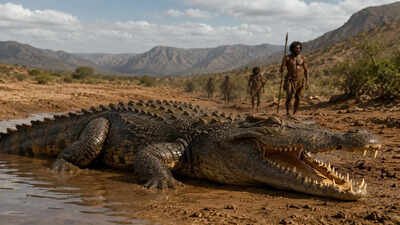
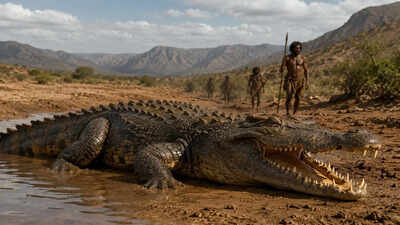
In the dry storytelling of palaeontology, certain discoveries tend to arrive with a kind of quiet disruption. Not the sort that rewrites textbooks overnight, but one that shifts the edges of what was assumed about a landscape long gone. In Ethiopia’s Afar region, a set of fragmented crocodile fossils has done something like that. The bones don’t just add another name to an already crowded prehistoric catalogue. They sit awkwardly alongside the well-told story of early hominins, including the famous skeleton known as Lucy, suggesting that the environment she moved through was far less forgiving than sometimes imagined. A newly described crocodile species, identified from these remains, appears to have shared rivers, floodplains and lake margins with her kind, occupying a position near the top of the food chain.
Scientists discover a giant crocodile from Lucy’s world and it may have been an apex predator
The animal has been given the name Crocodylus lucivenator, a label that loosely translates as “Lucy’s hunter”. The choice of name is not decorative. According to the University of Iowa, it anchors the species in a specific slice of time between roughly 3.4 and 3 million years ago, when early members of Australopithecus afarensis were moving through a shifting mix of woodland, wet grassland, and river channels in what is now northern Ethiopia.Lucy herself, the partial skeleton uncovered in the 1970s, has long been treated as a reference point for human evolution. She is not new to science, but she continues to frame how researchers picture the world she lives in. The crocodile’s name folds that human story back into something more uneasy: a reminder that those same water sources which supported early hominins were also home to large ambush predators.
This 15-foot crocodile turned ancient Hadar into a deadly ambush zone
The Hadar landscape is often reconstructed as a patchwork environment, part lake, part river corridor, with stretches of vegetation breaking up open ground. According to the study published in Journal of Systematic Palaeontology, titled ‘Lucy’s peril: A Pliocene crocodile from the Hadar Formation, north-eastern Ethiopia’, the crocodile described from this region was not small by any measure. Estimates place it at around 12 to 15 feet in length, with a mass that could easily exceed half a ton. Its proportions suggest a predator built for waiting rather than pursuit, lying just beneath the surface or half-hidden among reeds, motionless until something came close enough.What makes it stand out is not just size, but its position in that ecosystem. Carnivores such as large felids and scavenging hyenas were present in the wider region, yet within this particular habitat, this crocodile appears to have been the dominant threat along the water’s edge. The margins of rivers, so often treated in early human narratives as resource-rich corridors, would also have been zones of ambush.
What 100 broken bones revealed about a crocodile
The material used to define the species did not arrive as a single clean specimen. Instead, it came from more than a hundred scattered fragments: parts of skulls, sections of jaw, isolated teeth. All of them recovered from the Hadar Formation over years of fieldwork.Individually, none of the pieces would have been enough to say much. Together, they began to show a pattern that didn’t match known African crocodiles from the same period. The skull anatomy in particular carries a mix of traits that felt out of place, including a raised structure along the snout that stands out when compared with modern Nile crocodiles in the region.There is a familiarity to some of these features when placed against living crocodilians elsewhere in the world, but not in East Africa. That mismatch is what first drew attention when the fossils were re-examined in museum collections years after their discovery.
Midline snout structure and courtship behaviour in ancient crocodiles
Among the more unusual characteristics is a pronounced bulge along the midline of the snout. It is not the sort of feature that changes how the animal moves or hunts, but it may have altered how it appeared to others of its kind.In modern crocodiles, similar structures sometimes appear in males during display behaviour. They can be part of visual signalling during courtship or territorial encounters, subtle cues rather than obvious ornaments. The presence of a comparable feature here raises the possibility that this extinct species also relied on visual displays alongside its physical dominance in the water.Its snout also extends further ahead of the nostrils than in several other crocodile lineages of the time, giving it a slightly different feeding profile. Nothing about it suggests an animal struggling to survive in its environment. If anything, it reads as a successful design for a specific niche: patient, submerged, and capable of explosive movement over short distances.
Evidence of violence preserved in bone
Some of the clearest insights into behaviour come not from complete skeletons but from damage. One jaw fragment shows signs of injury that had begun to heal before the animal died. The pattern is consistent with face-to-face combat, something seen in living crocodiles today when individuals clash over territory or mating rights.The survival of such injuries suggests encounters that were intense but not always fatal. Crocodilian behaviour rarely needs much imagination to interpret in this context; the anatomy of modern species offers a baseline that stretches back millions of years with surprisingly little change.What cannot be determined is the outcome of that specific fight, or how often such confrontations occurred. Only that they did, and that this individual lived long enough afterwards for the bone to repair itself.
How one crocodile species shaped access to water in early human environments
One of the more striking aspects of the discovery is how isolated this crocodile appears within its immediate environment. While other crocodilian species existed further along the eastern rift system, this particular region seems to have been dominated by a single form.That dominance would have shaped everything around it. Any animal approaching water would have been doing so at risk. Early hominins included. Even brief visits to riverbanks for drinking or foraging would have carried exposure to an unseen threat just beneath the surface.The landscape itself was not static. Forested patches shifted into open grassland and back again as water levels changed and climates fluctuated. Through those shifts, this crocodile appears to have remained present, adapting without leaving obvious signs of replacement by competing species.