
A mysterious Easter Island script may be older than European contact, suggesting they invented writing independently |

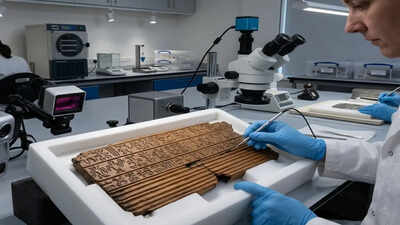
An ancient script from Easter Island is set to rewrite human history. A scientific study sparked debates about whether this remote island had invented writing independently. Researchers discovered a new clue from one of the world’s most isolated islands, and this raises questions about the origins of the remote Chilean volcanic island in the South Pacific.Famous for its nearly 900 monumental statues, known as moai, created by the Rapanui people between the 13th and 16th centuries, Easter Island is a UNESCO World Heritage site. The place is renowned for its extreme isolation and its unique archaeological landscape.The scientific study has brought up new doubts regarding radiocarbon dating, which was employed in studying the age of some wooden tablets covered with a script known as Rongorongo. The study shows that some tablets date back to a period prior to the arrival of Europeans in 1722.If this is proven true, the Rapa Nui inhabitants would be proven to have invented their writing style independently. This would also mean that the Rongorongo script ranks among the few writing systems invented without any external influences.What is Rongorongo?Rongorongo is a writing system that comprises carved symbols, known as glyphs, on wooden tablets and artefacts discovered in Easter Island. Rongorongo differs from other scripts in that it has not yet been deciphered. Rongorongo was noted for the first time in 1864 when it was observed by Europeans.According to research published in Scientific Reports, led by Silvia Ferrara, an archaeologist and linguist at the University of Bologna, Italy, Rongorongo looks very different from European writing systems. This has led some experts to believe it may have developed locally by the inhabitants.What the new study discovered?The researchers examined four wooden items with Rongorongo script engravings.Radiocarbon dating helped them determine roughly when the wood from which the tablets were made was harvested. In particular, one tablet was dated to 1493-1509, meaning it is around 200 years older than the arrival of Europeans on the island. It shows that at least some of the writing materials existed long before the first visitors.The authors noted in their paper that the issue is absolutely critical, adding that should the system be older than the arrival of foreigners, it will be considered yet another instance of writing in human civilisation.There are very few places where humans developed independent scripts, namely Mesopotamia, Egypt, China, and Mesoamerica, according to a study by the University of Chicago. If Rongorongo joins this small group, it will become the latest one.

Easter Island is a UNESCO World Heritage site. Image credit – Gemini
Rongorongo’s discovery cannot be considered conclusiveEven though the results are encouraging, scientists are far from certain about them. Radiocarbon dating determines the age of cutting rather than engraving. This means there is a possibility that an older piece of wood was reused. As Ferrara mentions, it makes no sense to carve into an ancient piece of wood.Another issue is the small number of tablets sampled. One out of four tablets examined appeared to have been created before the European contact. All other tablets appeared to be much younger.Scientists would need to analyse more tablets in order to verify their hypothesis. This task is difficult to accomplish since only about 27 Rongorongo artefacts have survived through the centuries. These artefacts are located all over the world in various museums.Relevance of Rongorongo for human historyUnderstanding whether or not the Rongorongo characters were created independently would make a substantial contribution to human history. Writing systems usually serve as indicators of the emergence of complex societies and cultures.The existence of an independently developed script would emphasise the intellectual and cultural capabilities of the Rapa Nui society. It would also disprove earlier hypotheses regarding the role of external factors in the creation of new scripts among isolated societies.Easter Island is considered one of the remotest inhabited islands in the world. Located about 2,360 miles from the coast of Chile, the island was settled by Polynesians between 1150 and 1280 AD.What are the next steps?More studies are needed for creating a more accurate timeline, which requires gaining access to additional Rongorongo tablets and improving dating techniques. Meanwhile, scholars continue making ongoing attempts to decipher the mysterious script. To date, no one has managed to translate it entirely. The lack of any translation makes it impossible to determine the use of this writing system.However, these findings can serve as a solid starting point for future research on the issue. The results indicate that the history of the development of writing in the region might be more complicated than expected.Although the assumption that an isolated civilisation developed its unique writing system is intriguing, the puzzle is yet to be solved. For now, the Rongorongo script is considered one of the most inexplicable linguistic phenomena worldwide. Further investigation might reveal some fascinating insights into the lives of the islanders.