NSO: Out-of-pocket spending still drives hospitalisation costs


Despite a substantial increase in the coverage of health insurance or finance schemes, which only cover inpatient treatment, between 2017-18 and 2025, out-of-pocket expenditure by patients and their families still accounts for almost all of the spending on hospitalisation. This was revealed in the latest household consumption survey on health conducted by the National Statistical Office (NSO) in the Jan-Dec 2025 period.In the 2017-18 survey, over 90% of the hospitalisation expenses were shown to be borne by the patient through household income or savings and borrowings, with sale of physical assets and contribution from friends and relatives making up most of the remaining. At the time, coverage of govt-sponsored health insurance or financing schemes was just 13% in rural areas and 9% in urban India.
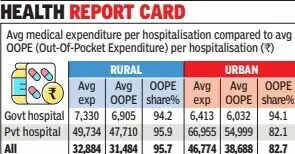
Health report card
In this survey, the coverage has increased to almost 46% and 32% respectively. However, out-of-pocket expenditure on hospitalisation still accounted for an average of Rs 31,500 per hospitalisation or almost 95% of the average total spend on each episode of hospitalisation in rural areas. In urban India, the average hospitalisation expenditure was almost Rs 47,000 and the average OOPE for hospitalisation about Rs 39,000, or around 83% of the total.A similar pattern is reflected in the data on the cost of childbirth as well. The average out-of-pocket expenditure per childbirth was almost as much as the average medical expenditure per childbirth. The average OOPE seems to be slightly less than the average medical expenditure for childbirth and for hospitalisation in urban India which might be an indication that the health schemes are being utilised better in urban India.The average medical expenditure due to hospitalisation has almost doubled between 2017-18 and 2025, with rural India showing greater increase. The jump was 97% in rural areas compared to 77% in urban areas. Unsurprisingly, hospitalisation in private facilities accounted for a bigger jump than in public facilities.Interestingly, overall hospitalisation rate (hospitalisation cases per 1,000 persons) has remained the same at 29 in the last survey and the latest one. While rural hospitalisation rate increased from 26 cases per 1,000 to 29, in urban areas it has gone down from 34 to 32.