







NEW DELHI: Over 4 out of every 10 petrol cars registered in Delhi over the past 15 years fall in the below BS 6 category, while four out of every 10 petrol two-wheelers are likely to be affected if the Supreme Court‘s observation on restricting such vehicles were to be implemented.This point to a potentially significant impact on private vehicle owners, particularly those using older petrol vehicles.A review of vehicle registration data from 2012 to 2026 shows that nearly 8.4 lakh out of 18.9 lakh petrol cars registered in Delhi during this period were below BS 6, accounting for 44.3% of the total. Similarly, 17.3 lakh out of 42.8 lakh petrol two-wheelers registered during these 15 years fell in the below BS 6 category, accounting for 40.3%.However, these figures do not represent the number of such vehicles currently running on Delhi’s roads. Some vehicles registered in the city over the years may have become non-operational, while others may have been sold outside the city.
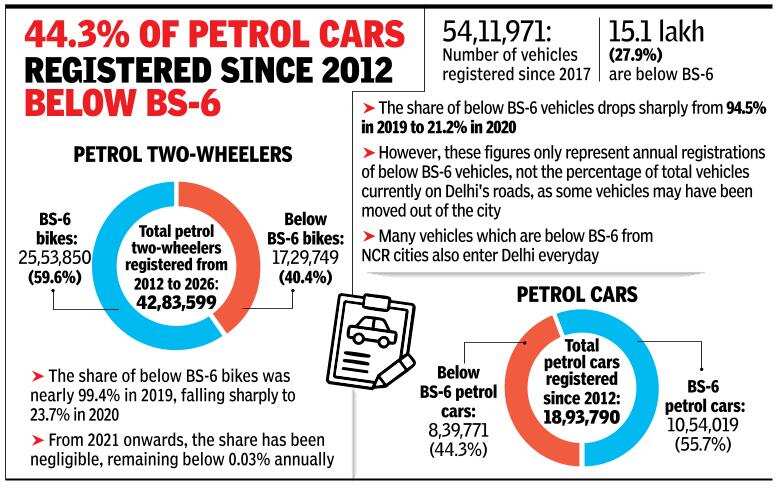
Under the existing guidelines, petrol vehicles are allowed a lifespan of 15 years in Delhi-NCR. As a result, many owners may continue using their vehicles until they approach the end of this permitted period, while others may sell them to buyers in different cities rather than scrap them, said a senior official.At the same time, the number of below BS-VI vehicles entering Delhi cannot be assessed through the capital’s registration figures alone. Vehicles registered in other parts of the country, particularly neighbouring NCR cities, also enter and run on Delhi’s roads every day.The broader registration data for all vehicle categories in Delhi over the past 10 calendar years, from 2017 to 2026, presents a different picture. Of the 54.1 lakh vehicles registered during this period, 15.1 lakh, or 27.9%, were below BS-VI standards. This means nearly three out of every 10 vehicles registered during these years fall in the category that could be affected by such a curb.The transition to BS-VI is particularly evident in the year-wise figures. In 2019, 94.5% of all vehicles registered in Delhi were below BS-VI, with only 25,750 of the 4.7 lakh vehicles falling in the BS-VI category. In 2020, however, the share of below BS -VI vehicles dropped sharply to 21.24%.From 2021 onwards, the share of below BS-VI vehicles among annual registrations remained negligible, ranging between 0.02% and 0.10%.BS-VI, or Bharat Stage-VI, is the sixth stage of India’s vehicle emission standards and imposes stricter limits on pollutants released by vehicles compared with earlier standards, including BS-IV. The norms regulate emissions such as nitrogen oxides, particulate matter, hydrocarbons and carbon monoxide. The objective is to reduce the amount of harmful pollutants released into the air by vehicles.The BS-VI standards became mandatory for new vehicle registrations from April 1, 2020 in several categories of vehicles. Vehicles manufactured under the newer standards are designed to emit lower levels of harmful pollutants, making them cleaner than vehicles complying with earlier emission norms.Supreme Court on Nov 23 orally mooted allowing only BS-VI-compliant vehicles to ply in Delhi as part of efforts to tackle air pollution particularly in winters. However, no immediate formal order enforcing such a restriction had been issued.If we assume that all petrol cars and two-wheelers that aren’t BS-VI registered in Delhi between 2012 and 2026 were to be replaced, the estimated expenditure for vehicle owners could touch Rs 75,831 crore.The calculation assumes a replacement cost of Rs 8 lakh per car and Rs 50,000 per motorcycle. Between 2012 and 2026, Delhi recorded 8.4 lakh such petrol cars. The replacement cost would translate into nearly Rs 67,182 crore, that for replacing 17.3 lakh two-wheelers would be nearly Rs 8,648 crore. The total cost would be nearly Rs 75,831 crore.A senior official, however, said estimating the replacement cost assumes that owner of a below BS-VI vehicle would buy a new vehicle if restrictions are imposed, which may not necessarily be the case.Many may choose not to replace their vehicles at all, particularly when factors like age and migration are considered. In several cases, owners of smaller cars may upgrade to bigger vehicles rather than buy a similar category, while some may decide against purchasing another vehicle, he said.Amit Bhatt, ICCT’s managing director for India, said, “The direction of travel must be towards technologies like electric vehicles, which produce zero tailpipe emissions.”Anil Chhikara, a former deputy commissioner of transport said, “Penalising compliant, well-maintained BS-IV vehicles doesn’t effectively address the root causes of vehicular pollution in Delhi-NCR.